DBLab vs Vela
clones of any Postgres vs branches on Vela
Vela is a self-hosted Postgres platform that branches its own databases with copy-on-write NVMe storage. DBLab clones any PostgreSQL where it already runs.
Where DBLab is ahead of Vela
Each point pairs what our documentation says with what the Vela documentation says. Follow the links and check.
Clones the Postgres you already run
One copy of the data, many clones
Catches a dangerous migration in CI
DBLabDB Migration Checker runs pending migrations on a clone in CI and fails those that hold dangerous locks longer than a limit, 10 seconds by default. docs
VelaVela describes creating a branch per pull request from the UI or an API, then running migrations and tests on it. The sources we reviewed do not describe a check that fails a migration on lock duration. 3
Short answer
Vela, from simplyblock, is a self-hostable Postgres platform built from a fork of Supabase Studio and simplyblock's NVMe storage. Branches and clones of a Vela database are copy-on-write at the block level, and each runs as its own instance. Existing databases are loaded into Vela with pg_dump and psql. simplyblock announced the public beta in February 2026. DBLab Engine is open-source software that makes thin clones of any PostgreSQL, including managed services, without moving it. Pick Vela if you want to run your Postgres on a self-hosted platform with branching built in; pick DBLab to clone databases that stay where they are.
When Vela is the better choice
- Branching is built into the platform your databases run on, in your own infrastructure, with block-level copy-on-write that Vela says forks 1TB in under a second at the storage layer.
- A full Postgres platform, not only copies: Vela Studio, RBAC, scheduled backups with point-in-time restore, and separate scaling of compute and storage.
- Each branch is a separate database instance with its own resource limits, so tests on one branch run on their own compute.
- The code is open source under Apache 2.0 or MIT.
- A free hosted sandbox with 2 vCPU, 4 GiB RAM and 100 GiB NVMe to try it before self-hosting.
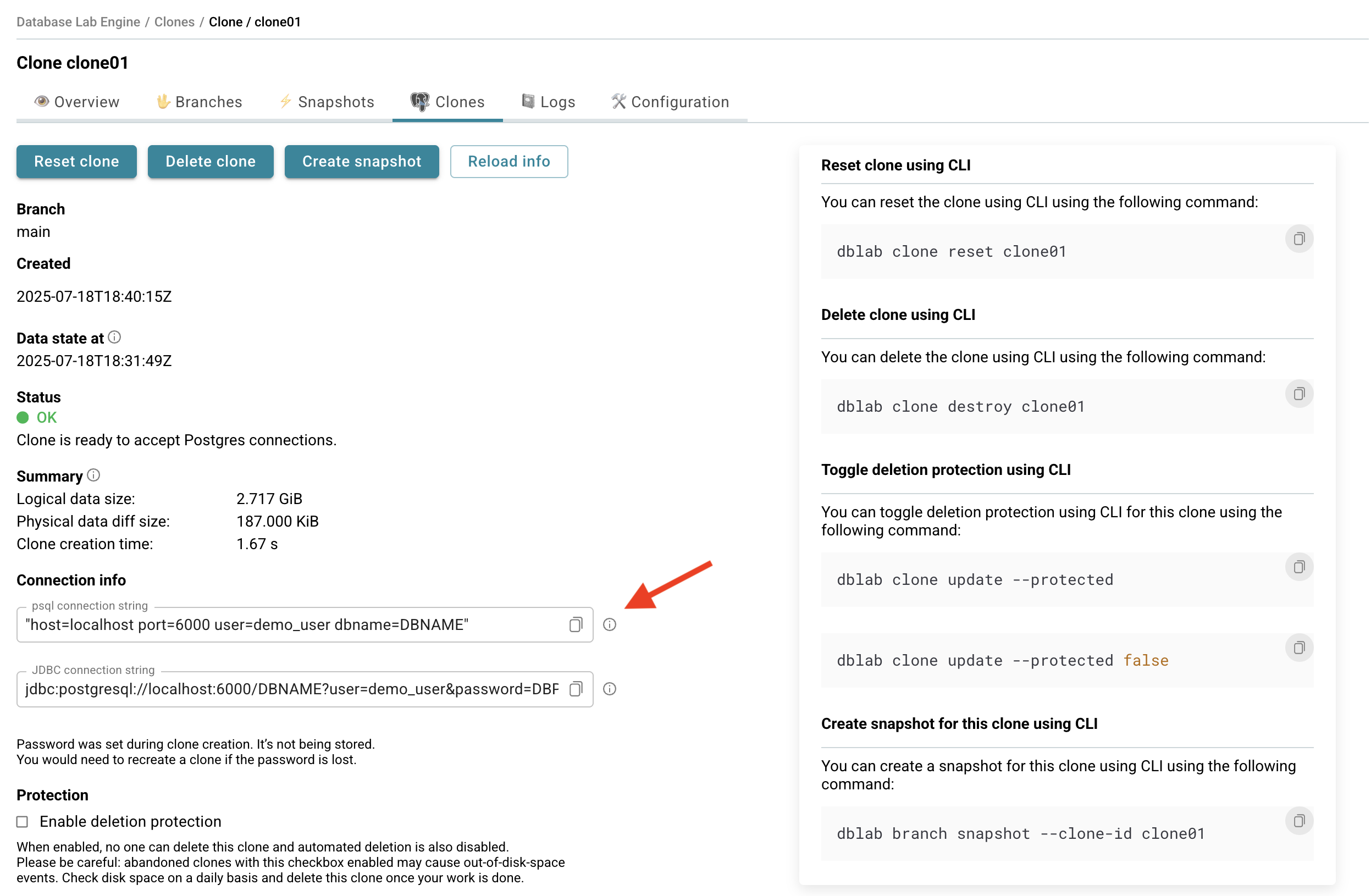
What you get
A clone in the DBLab UI, ready for connections 1.67 seconds after it was requested (a 2.7 GiB demo database). How it works
DBLab and Vela, side by side
| Question | DBLab | Vela |
|---|---|---|
| What it is | Open-source software that gives every developer, CI job and AI agent a writable, full-size copy of a PostgreSQL database in seconds. Thin clones share one physical copy of the data on one machine. docsdocs 2 | A self-hostable, serverless Postgres development platform with database branching and separate scaling of compute and storage. It combines a fork of Supabase Studio, a controller and simplyblock storage. 510 |
| Which databases it can copy | YesAny PostgreSQL from version 10 up, wherever it runs. Managed services such as Amazon RDS, Aurora, Cloud SQL and Supabase are copied with dump and restore; self-managed servers can also be copied physically with WAL-G, pgBackRest or pg_basebackup. docsdocs 2 | PartlyBranches and clones are made from branches in a Vela project. Existing data is loaded with pg_dump and psql for Postgres-to-Postgres moves, or with CSV and pgloader imports; the sources we reviewed do not describe ongoing sync from an external database. 68 |
| How a copy is made | Copy-on-write in the file system, with ZFS or LVM. Clones share unchanged blocks, so a clone takes extra disk space only for what it changes. docs | Copy-on-write at the block level in simplyblock's distributed NVMe storage. A fork or snapshot is a metadata-only operation; a VM is then provisioned and the volume attached. 43 |
| Time to get a copy | A few seconds whatever the database size: under 2 seconds for a 10 TiB database with one user, up to 30 seconds with 15 users at once. The first copy of the source is slow; about 1 TiB an hour is a good speed. docsdocs 2 | Vela says forking a 1TB database typically completes in under one second at the storage layer and that clone time is independent of data size. The clone guide says it "may take a few moments"; a new database usually takes less than a minute. 467 |
| Data in a copy | YesThe whole database as of the chosen snapshot. Physical mode can follow the source continuously; logical mode is refreshed in full, on a schedule. docsdocs 2 | YesCloning a branch copies the schema, data and configuration into a new, independent branch. Branches can also start from a snapshot, and scheduled backups allow point-in-time restore. 6313 |
| Masking sensitive data | YesDocumented options: load an anonymized dump, or apply SQL transformations or PostgreSQL Anonymizer before snapshots are taken. You define the rules. docs | Not documentedNot documented in the sources we reviewed. 31 |
| CI and migration testing | YesDB Migration Checker runs pending migrations on a clone in CI, fails those that hold dangerous locks longer than a limit (10 seconds by default) and collects statistics. Any CI job can also create clones through the API or CLI. docs | PartlyVela describes a pipeline that creates a branch for a pull request, runs tests and migrations, then deletes it. The sources we reviewed include no CI integration, API or CLI reference for that workflow. 3 |
| API, CLI and agent access | REST API, web UI and the dblab CLI. Joe, also available as pgai joe, returns EXPLAIN plans and timings from a clone, not rows. docsdocs 2docs 3 | Vela Studio, a web dashboard, for projects, branches and clones. Vela's branching page says branches can be created from the UI or an API; the sources we reviewed do not include an API, CLI or MCP reference for branch operations. 63 |
| Where it runs | YesOn a machine you control, in any cloud or on-premises. DBLab SE installs from the PostgresAI Console or AWS Marketplace. docsdocs 2 | YesSelf-hosted on Kubernetes, OpenShift, bare metal or VMs, on AWS, GCP, Azure or on-premises. simplyblock announced the public beta on February 9, 2026. A free hosted sandbox is offered for evaluation. 910412 |
| Open source | YesDBLab Engine is open source under Apache 2.0. docs | Yes"All code is either Apache License 2.0 or MIT licensed." The main simplyblock/vela repository is under Apache 2.0. 1011 |
| Documented limits | DBLab SE: 2,000 GiB per instance and a single user. All clones share one machine, and copy-on-write storage has different I/O performance, so timings on a clone should not be compared directly with production. docsdocs 2 | Sandbox: 2 vCPU, 4 GiB RAM, 100 GiB NVMe and 10,000 IOPS; databases pause after inactivity and public internet transfer is blocked. The sources we reviewed do not state limits for self-hosted deployments. 212 |
| What you pay for | One machine and one physical copy of the data, however many clones run. DBLab SE is billed hourly by the size of that machine, not by database size or number of clones. docs | Self-hosted Enterprise is licensed per vCPU, at a custom price that depends on deployment scope; compute and storage run on your own infrastructure. The sandbox is free. 42 |
Pricing
| Product | Plan | List price | Notes |
|---|---|---|---|
| DBLab | DBLab Engine | Free | Open source, Apache 2.0; you run it |
| DBLab | DBLab SE | From $62/month | Billed hourly by machine size, plus your own cloud costs; 2,000 GiB limit; single user |
| DBLab | DBLab EE | Custom | Annual contract, from $0.2662 per 100 GiB per hour; unlimited database size, SSO |
| Vela | Vela Sandbox | Free | Hosted, for evaluation; 2 vCPU, 4 GiB RAM, 100 GiB NVMe, 10,000 IOPS; branches and clones bound by these resources 212 |
| Vela | Enterprise | Custom | Self-hosted on Kubernetes, OpenShift or private cloud; licensed per vCPU; priority support and rollout engineering 24 |
List prices on 18 Nov 2026. The billing units differ, so this is not a total-cost comparison. DBLab pricing
Questions
- Is Vela open source?
- Yes. simplyblock says all Vela code is under Apache 2.0 or MIT, and the main repository on GitHub is Apache 2.0. Enterprise support for self-hosted deployments is sold separately. 10112
- Can Vela branch a database that runs on Amazon RDS?
- Not in place. Vela branches databases in a Vela project, so an existing database has to be loaded first; the docs recommend pg_dump and psql. DBLab clones such databases where they are, by dump and restore. 86
Try a clone before you install anything
The public demo runs DBLab Engine: open it with the token demo-token, create a clone and connect to it. DBLab Engine is open source, so the next step is a machine of your own.
Sources
- Vela home page
- Vela pricing
- Vela: Database branching
- Vela: Vela Storage
- Vela docs: Important notes
- Vela docs: Clone your database
- Vela docs: Create your first branch
- Vela docs: Import data
- simplyblock press release: Vela beta launch
- Vela blog: Vela is open source
- simplyblock/vela repository
- Vela Sandbox
- Vela features
These pages compare what each product does for PostgreSQL; other databases and the rest of the stack are out of scope. What we say about the other product comes from its own documentation, pricing page, changelog or source repository, read on the date shown; each row cites its source. "Not documented" means we did not find it in those sources, not that the product cannot do it. Prices are list prices and the billing units differ, so they are not a total-cost comparison. Product names are trademarks of their owners. Found a mistake? Tell us and we will correct the page.
More comparisons
- Databricks Lakebaseclones of any Postgres vs Lakebase branches
- Neonclones of any Postgres vs branches on Neon
- PlanetScaleclones in seconds vs branches restored from backup
- Supabase Branchingfull-size copies vs preview branches
- Tiger Dataclones of any Postgres vs Tiger Cloud forks
- Xatathin clones on one machine vs a branching platform
- Amazon Aurora cloningclones of any Postgres vs Aurora clusters
- Amazon RDS Blue/Green Deploymentstest clones vs a switchover
- All comparisons