PostgresAI vs Postgres MCP Pro
always-on monitoring vs an MCP server
Postgres MCP Pro is an open-source MCP server with health checks and hypopg index tuning. PostgresAI monitors continuously, and a DBLab clone runs an index on real data.
Where PostgresAI is ahead of Postgres MCP Pro
Each point pairs what our documentation says with what the Postgres MCP Pro documentation says. Follow the links and check.
Test the fix on a full-size copy first
PostgresAIWith DBLab Engine, a separate open-source product, an index or query change runs on a full-size thin clone of the database, created in seconds, before it reaches production. docsdocs 2
Postgres MCP ProPostgres MCP Pro estimates the effect of candidate indexes with hypopg, which simulates how the planner would use them, and compares plans before and after each index. The README notes that this relies on the accuracy of the hypopg predictions. 1
Wait events with no extra extension
PostgresAIAn ASH-style wait event dashboard built from samples of pg_stat_activity. No extra extension is needed. docs
Postgres MCP ProPostgres MCP Pro provides its functions through nine MCP tools, listed in the README: schemas, objects, SQL, EXPLAIN, top queries, index analysis and health checks. None of them covers wait events. 1
Every finding comes with a fix
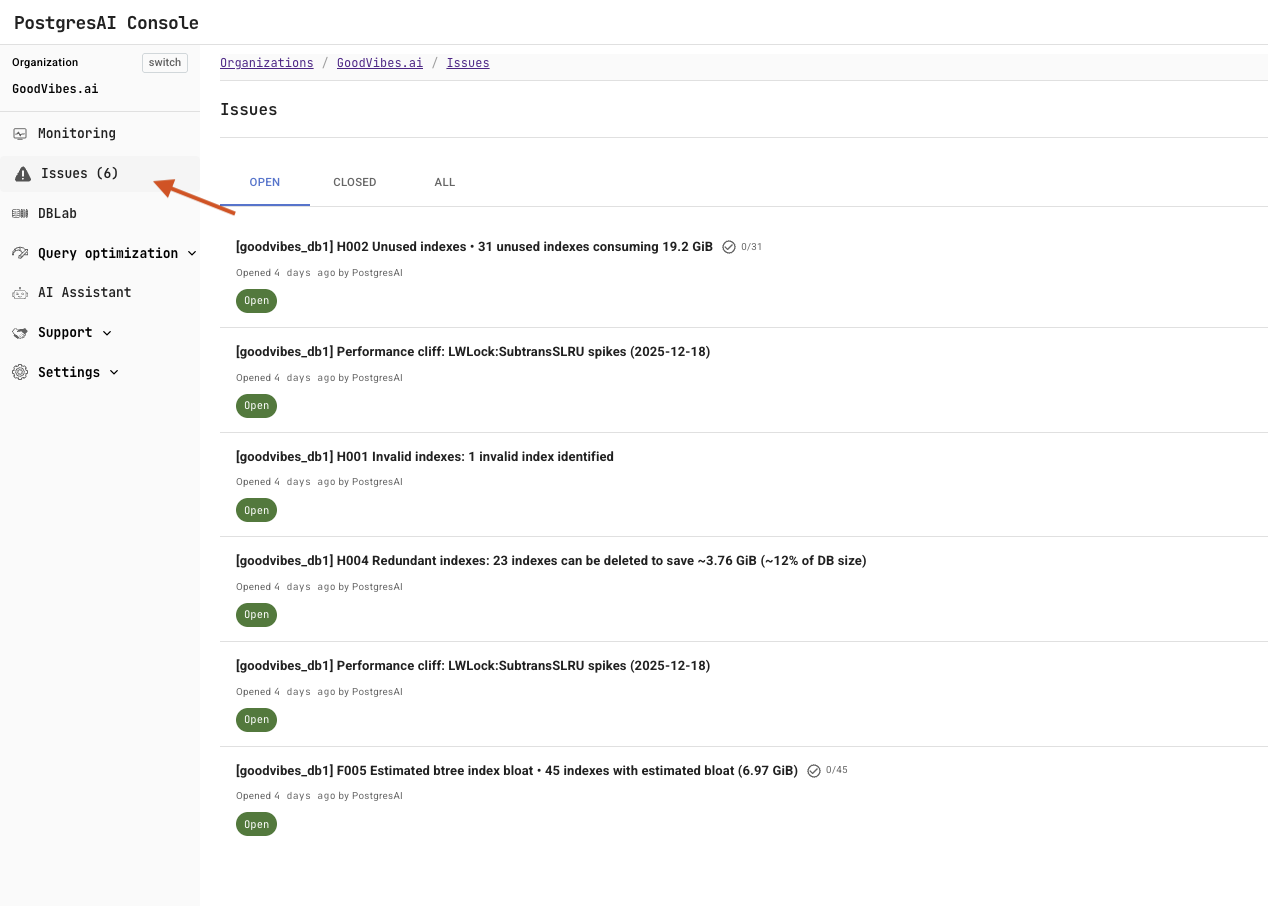
PostgresAIScheduled checkups turn each finding into an Issue with severity, evidence and a specific fix. docsdocs 2
Postgres MCP ProPostgres MCP Pro runs health checks adapted from PgHero when an agent calls analyze_db_health. The README says the team is working to fully validate these checks and may extend them. 1
PostgreSQL experts on the plan
PostgresAIScale includes two expert requests a month, answered within 24 business hours. Either plan can buy a one-off pack of two requests for $500. docsdocs 2
Postgres MCP ProThe Postgres MCP Pro README points to GitHub issues, pull requests and a Discord server for questions and requests. 1
Short answer
Postgres MCP Pro is an open-source MCP server under the MIT license. An AI agent calls its tools on demand to list schemas, run SQL in a read-only or unrestricted mode, get EXPLAIN plans, find top queries, run PgHero-based health checks and search for indexes with hypopg. Its tools read the database at the time of the call; the sources we reviewed do not describe stored history. PostgresAI monitors Postgres continuously, runs scheduled checkups and turns findings into Issues that you, your AI agent or a PostgresAI expert can act on. Pick Postgres MCP Pro for a free, local tool that gives an agent direct access to one database. Pick PostgresAI for history, alerts and expert help. An agent can use both.
When Postgres MCP Pro is the better choice
- Free and open source under the MIT license; it runs locally with Docker or Python 3.12 and needs only a connection string.
- Workload index tuning: a greedy search adapted from Microsoft's Anytime algorithm, with hypopg to predict plan cost for each candidate set of indexes.
- An execute_sql tool for the agent, with a restricted mode that runs read-only transactions with a time limit and an unrestricted mode for development.
- explain_query can show the plan with hypothetical indexes, so an index idea is checked against the planner before anyone creates it.
- Health checks for index, vacuum, connection, buffer cache, replication, constraint and sequence health, adapted from PgHero.
What you get
Checkup findings as Issues in the PostgresAI Console. How it works
PostgresAI and Postgres MCP Pro, side by side
| Question | PostgresAI | Postgres MCP Pro |
|---|---|---|
| What it is | PostgreSQL monitoring with scheduled health checkups. Findings become Issues with severity, evidence and a recommended fix, which you, your AI agent or a PostgresAI expert can act on. docsdocs 2 | An MCP server that an AI agent calls on demand, with 9 tools: schema listing, object details, SQL execution, EXPLAIN, top queries, workload and per-query index recommendations, and database health checks. The sources we reviewed do not describe continuous metric collection. 1 |
| Where your Postgres can run, and which versions | YesAmazon RDS and Aurora, Google Cloud SQL, Azure Database for PostgreSQL, Supabase, Tiger Data, self-managed servers and Postgres running on Kubernetes. PostgreSQL 14 and newer, with the pg_stat_statements extension. docs | YesAny PostgreSQL reachable with a connection URI. The README gives extension setup for AWS RDS, Azure and Google Cloud SQL, and for self-managed Postgres, and says testing focuses on PostgreSQL 15, 16 and 17, with support planned for 13 through 17. Index tuning and query analysis need pg_stat_statements and hypopg. 1 |
| Where it runs and what it collects | YesHosted by PostgresAI, or self-hosted in your own cloud account or on your own server. It collects database metadata such as statistics, normalized query texts and wait events, not table data or query parameters. docsdocs 2 | YesYou run it: a Docker image or a Python package, started by the MCP client over stdio, or as a shared server over SSE. It reads the database when a tool is called; execute_sql results, which can include table rows, go to the calling LLM. 12 |
| Open source | YesThe monitoring software is open source under Apache 2.0. Hosted plans are a separate paid service. docsdocs 2 | YesOpen source under the MIT license; the license file reads Copyright (c) 2025, Crystal Corp. 51 |
| Query performance analysis | YesTop queries from pg_stat_statements by calls, execution time, planning time and rows, with a drill-down dashboard for a single query. For execution plans, Joe runs EXPLAIN on a DBLab clone. docsdocs 2 | Yesget_top_queries reports the slowest queries from pg_stat_statements by total or mean execution time. explain_query returns the execution plan, optionally with hypothetical indexes. 1 |
| Wait event analysis | YesAn ASH-style wait event dashboard built from samples of pg_stat_activity. No extra extension is needed. docs | Not documentedNot documented in the sources we reviewed. The listed tools do not include wait event analysis. 1 |
| Health checks and recommendations | YesScheduled checkup reports on settings, autovacuum and bloat, and indexes (invalid, unused, redundant). Each finding becomes an Issue with severity, evidence and a specific fix. docsdocs 2 | Yesanalyze_db_health checks index health (unused, duplicate, bloated, invalid), buffer cache hit rate, connections, vacuum and wraparound, replication, invalid constraints and sequences near their limit. The README says the checks are adapted from PgHero. 1 |
| AI and agent access | YesThe postgresai CLI (alias pgai) and an MCP server with tools for Issues, action items and checkup reports. The setup guide covers Cursor, Claude Code, Windsurf and Codex. docsdocs 2 | YesIt is an MCP server. The README covers Claude Desktop and gives setup notes for Cursor, Windsurf, Goose and Qodo Gen. Transports are stdio and SSE; streamable HTTP was added on the main branch in January 2026, after the latest tagged release. 143 |
| Testing a fix before production | YesWith DBLab Engine, a separate open-source product: a full-size thin clone of the database in seconds, where an index or query change can be run on real data. DBLab is set up and priced separately. docsdocs 2 | Partlyhypopg simulates how the planner would use candidate indexes, and the index search compares plans before and after each index. These are planner cost estimates; the sources we reviewed do not describe running a change on a separate copy of the data. 1 |
| Human PostgreSQL experts | YesScale includes two expert requests a month, answered within 24 business hours. Either plan can buy a one-off pack of two requests for $500. Consulting is separate. docsdocs 2 | Not documentedNot documented in the sources we reviewed. The README points to GitHub issues and a Discord server for questions and requests. 1 |
| Alerts | Email and Slack alerts on Starter and Scale. docs | Not documented in the sources we reviewed. The tools answer when an agent calls them; the README does not describe scheduled checks or notifications. 1 |
| History kept | 14 days on Starter, 13 months on Scale, custom on Enterprise. docs | The sources we reviewed do not describe stored history. The tools read pg_stat_statements and system views on the connected database at the time of the call. 1 |
| Security attestations | SOC 2 Type 2 examination completed for the Security and Availability criteria, covering March 4 to June 4, 2026. The SOC 3 report is public. docs | Not documented in the sources we reviewed. It is software you run yourself, connected to your database with credentials you supply. 1 |
Pricing
| Product | Plan | List price | Notes |
|---|---|---|---|
| PostgresAI | Starter | $16 per cluster/month | Primary only, 14-day retention, no expert requests included |
| PostgresAI | Scale | $512 per cluster/month | Primary and up to 5 replicas in one cluster, 13-month retention, Grafana dashboards, 2 expert requests a month |
| PostgresAI | Enterprise | Custom | Contact sales |
| PostgresAI | Self-hosted | No licence fee | Open source under Apache 2.0; you run it yourself |
| Postgres MCP Pro | Open source | Free | MIT license; you run it. The experimental LLM index tuning needs an OpenAI API key 51 |
List prices on 18 Nov 2026. The billing units differ, so this is not a total-cost comparison. PostgresAI pricing
Using PostgresAI with Postgres MCP Pro
Both products have MCP servers, and both document setup for Cursor and Windsurf. An agent can use PostgresAI for monitoring history, checkup findings and Issues, and Postgres MCP Pro for direct SQL, EXPLAIN and hypopg index experiments on a database it connects to.
Questions
- Is Postgres MCP Pro open source?
- Yes, under the MIT license. It installs from Docker Hub or PyPI. PostgresAI monitoring is also open source, under Apache 2.0. 52
- Is Postgres MCP Pro still maintained?
- The latest tagged release on GitHub and PyPI is 0.3.0, from May 16, 2025. The main branch has later commits, the most recent on August 16, 2026, including streamable HTTP support. The GitHub repository is not archived. The README says the project is created and maintained by Crystal DBA. 3241
- Does Postgres MCP Pro monitor my database?
- It runs checks and queries when an AI agent calls one of its tools. The sources we reviewed do not describe continuous collection, stored history or alerts, which is what PostgresAI monitoring provides. 1
- Does Postgres MCP Pro work with Amazon RDS?
- Yes. It connects with a standard Postgres URI, and the README describes enabling pg_stat_statements and hypopg on AWS RDS, Azure and Google Cloud SQL with CREATE EXTENSION. 1
- Can I use PostgresAI and Postgres MCP Pro together?
- Yes. Both are MCP servers, so one agent can use PostgresAI for checkup findings and Issues and Postgres MCP Pro for SQL, EXPLAIN and hypothetical index tests on the same database. 1
Check it on your own database
The express checkup works with PostgreSQL 14 or newer. With --no-upload it needs no account and sends no report data to PostgresAI. It needs Node.js 18 or newer and a database role with pg_monitor. Compare what it finds with what your current tool shows for the same database.
Sources
- Postgres MCP Pro repository and README
- postgres-mcp on PyPI
- Postgres MCP Pro releases
- Postgres MCP Pro commit history
- Postgres MCP Pro license
These pages compare what each product does for PostgreSQL; other databases and the rest of the stack are out of scope. What we say about the other product comes from its own documentation, pricing page, changelog or source repository, read on the date shown; each row cites its source. "Not documented" means we did not find it in those sources, not that the product cannot do it. Prices are list prices and the billing units differ, so they are not a total-cost comparison. Product names are trademarks of their owners. Found a mistake? Tell us and we will correct the page.
More comparisons
- DBtunemonitoring and checkups vs automated parameter tuning
- EverSQLany provider vs AI query rewrites on Aiven
- OtterTuneopen-source monitoring vs ML knob tuning (closed)
- Readyset RDSTserver monitoring vs a desktop query agent
- Releemmonitoring with history vs config tuning it applies
- Amazon DevOps Guru for RDSany cloud vs ML on RDS (closing)
- Azure PostgreSQL built-in toolsany provider vs Azure only
- Cloud SQL Query Insightsany provider vs inside Cloud SQL
- All comparisons