PostgresAI vs Readyset RDST
server monitoring vs a desktop query agent
Readyset RDST is an open-source desktop agent that ranks slow-query fixes for PostgreSQL. PostgresAI keeps history on a server, and a DBLab clone tests a change first.
Where PostgresAI is ahead of Readyset RDST
Each point pairs what our documentation says with what the Readyset RDST documentation says. Follow the links and check.
13 months of history
PostgresAIScale keeps 13 months of history. docs
Test the fix on a full-size copy first
Metadata only, and it can stay with you
PostgreSQL experts on the plan
PostgresAIScale includes two expert requests a month, answered within 24 business hours. Either plan can buy a one-off pack of two requests for $500. docsdocs 2
Readyset RDSTRDST's troubleshooting page sends users who are still stuck to Give feedback in the app or to the RDST Discord. The sources we reviewed do not describe PostgreSQL expert help for RDST. 18
Short answer
Readyset RDST is an open-source desktop app and CLI under Apache 2.0. On PostgreSQL it reads pg_stat_statements every minute from your computer, deep-analyzes the heaviest queries with an LLM, and keeps a ranked list of index, rewrite, settings and maintenance actions. Readyset says it never writes to the database. PostgresAI monitors Postgres from a hosted or self-hosted server, runs scheduled checkups and turns findings into Issues that you, your AI agent or a PostgresAI expert can act on. Pick RDST for a free local agent on one computer. Pick PostgresAI for server-side monitoring, longer history and expert help.
When Readyset RDST is the better choice
- Free and open source under Apache 2.0, with a desktop app for macOS (Apple Silicon), Windows and Linux and a CLI.
- A ranked list of Actions: each index or rewrite is scored by its queries' share of database time times the expected speedup, with the SQL to run and undo SQL for indexes.
- Measures each change after you ship it and marks it Verified, with before and after latency, or Didn't help.
- Each action can be copied as a migration for Alembic, Prisma, Rails or Flyway, and PostgreSQL index changes use CREATE INDEX CONCURRENTLY and DROP INDEX CONCURRENTLY.
- Hosted AI is free with a Readyset sign-in, and an Anthropic key of your own raises AI monitoring from 3 to 10 databases. Local monitoring keeps running without AI.
What you get
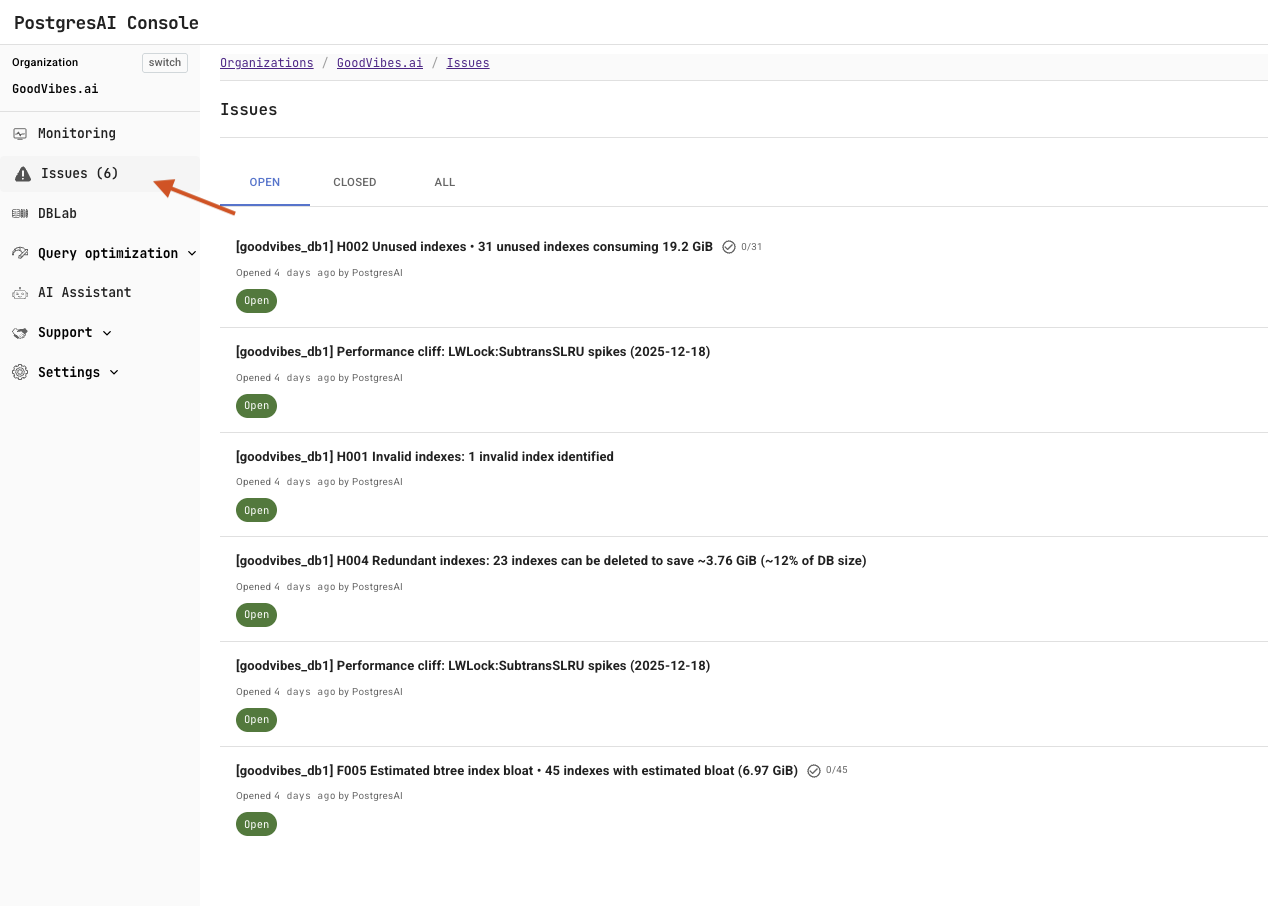
Checkup findings as Issues in the PostgresAI Console. How it works
PostgresAI and Readyset RDST, side by side
| Question | PostgresAI | Readyset RDST |
|---|---|---|
| What it is | PostgreSQL monitoring with scheduled health checkups. Findings become Issues with severity, evidence and a recommended fix, which you, your AI agent or a PostgresAI expert can act on. docsdocs 2 | A desktop agent and CLI that run on your computer. The agent reads query statistics every minute, deep-analyzes the heaviest queries and keeps ranked Actions for indexes, rewrites, settings and maintenance. The CLI adds top, analyze, ask, scan, audit and Readyset cache commands. 1456 |
| Where your Postgres can run, and which versions | YesAmazon RDS and Aurora, Google Cloud SQL, Azure Database for PostgreSQL, Supabase, Tiger Data, self-managed servers and Postgres running on Kubernetes. PostgreSQL 14 and newer, with the pg_stat_statements extension. docs | YesPostgreSQL 13 and newer, with pg_stat_statements, on any database the computer can reach, including through a VPN or SSH jump host. The connect page finds RDS and Aurora databases through your AWS account and imports databases from Supabase, Neon and DigitalOcean. 189 |
| Where it runs and what it collects | YesHosted by PostgresAI, or self-hosted in your own cloud account or on your own server. It collects database metadata such as statistics, normalized query texts and wait events, not table data or query parameters. docsdocs 2 | YesRuns on your computer; monitoring stops when you quit the app or the computer sleeps. History stays in a local folder. AI features send SQL text, plans, schema metadata and sampled parameter values, not query result rows, to the Readyset-hosted model or to Anthropic with your own key. 521039 |
| Open source | YesThe monitoring software is open source under Apache 2.0. Hosted plans are a separate paid service. docsdocs 2 | YesOpen source under Apache 2.0; the repository holds the CLI and the Electron desktop app. 39 |
| Query performance analysis | YesTop queries from pg_stat_statements by calls, execution time, planning time and rows, with a drill-down dashboard for a single query. For execution plans, Joe runs EXPLAIN on a DBLab clone. docsdocs 2 | YesPer-query calls per second, average latency and share of database time, with a deep analysis score out of 100. rdst analyze runs EXPLAIN, and EXPLAIN ANALYZE unless --fast is set, and returns candidate indexes and rewrites produced by an LLM. 1171 |
| Wait event analysis | YesAn ASH-style wait event dashboard built from samples of pg_stat_activity. No extra extension is needed. docs | Not documentedNot documented in the sources we reviewed. Readyset's post says the agent looks for queries that started waiting on locks, and rdst top and rdst audit can sample pg_stat_activity; the sources do not describe wait event analysis. 91213 |
| Health checks and recommendations | YesScheduled checkup reports on settings, autovacuum and bloat, and indexes (invalid, unused, redundant). Each finding becomes an Issue with severity, evidence and a specific fix. docsdocs 2 | YesDatabase checks run every 15 minutes and feed settings and maintenance Actions, scored by severity. rdst audit reports version, size, connections, cache hit rate, an instance sizing class and LLM index recommendations. 413 |
| AI and agent access | YesThe postgresai CLI (alias pgai) and an MCP server with tools for Issues, action items and checkup reports. The setup guide covers Cursor, Claude Code, Windsurf and Codex. docsdocs 2 | Yesrdst claude registers RDST's MCP tools with Claude Code: targets, query analysis, audits, fleet, caches and code scans. The integration does not expose the agent Inbox or nightly reports. Data agents expose a narrower MCP interface. 14 |
| Testing a fix before production | YesWith DBLab Engine, a separate open-source product: a full-size thin clone of the database in seconds, where an index or query change can be run on real data. DBLab is set up and priced separately. docsdocs 2 | PartlyDeep analysis tests suggested rewrites and keeps one if it ran 20% faster or the planner estimates 20% less work. rdst analyze runs EXPLAIN ANALYZE on the target, and benchmarks run read queries on the live database. The sources we reviewed do not describe testing on a separate copy of the data. 4117 |
| Human PostgreSQL experts | YesScale includes two expert requests a month, answered within 24 business hours. Either plan can buy a one-off pack of two requests for $500. Consulting is separate. docsdocs 2 | Not documentedNot documented in the sources we reviewed for RDST. 12 |
| Alerts | Email and Slack alerts on Starter and Scale. docs | Desktop notifications and browser notifications while an RDST tab is open, for an unreachable database, a query running over a minute, query or plan changes and database-wide changes. The docs say email and phone alerts are not available yet. 15 |
| History kept | 14 days on Starter, 13 months on Scale, custom on Enterprise. docs | Per-minute readings for 48 hours for the top 1,000 queries, 5-minute readings for 7 days, hourly readings for 90 days and daily readings as long as monitoring has room. Other tracked queries keep 5-minute readings for 48 hours and hourly readings for 30 days. Local storage is 250 MB per database by default. 10 |
| Security attestations | SOC 2 Type 2 examination completed for the Security and Availability criteria, covering March 4 to June 4, 2026. The SOC 3 report is public. docs | The sources we reviewed do not describe security attestations for RDST. Monitoring history stays on your computer and database passwords are kept in the operating system keychain. 10 |
Pricing
| Product | Plan | List price | Notes |
|---|---|---|---|
| PostgresAI | Starter | $16 per cluster/month | Primary only, 14-day retention, no expert requests included |
| PostgresAI | Scale | $512 per cluster/month | Primary and up to 5 replicas in one cluster, 13-month retention, Grafana dashboards, 2 expert requests a month |
| PostgresAI | Enterprise | Custom | Contact sales |
| PostgresAI | Self-hosted | No licence fee | Open source under Apache 2.0; you run it yourself |
| Readyset RDST | Open source | Free | Apache 2.0; runs on your computer 39 |
| Readyset RDST | Hosted AI with a Readyset sign-in | Free | Readyset says hosted inference is on us for signed-in users, with a default allowance; AI monitoring on up to 3 databases per account, or 10 with your own Anthropic key 17216 |
List prices on 18 Nov 2026. The billing units differ, so this is not a total-cost comparison. The docs state a monthly AI usage limit per account without giving the amount. The Readyset pricing page lists plans for the Readyset cache, not for RDST. PostgresAI pricing
Using PostgresAI with Readyset RDST
RDST connects with a read-only account to any PostgreSQL it can reach, and PostgresAI monitoring works with the same managed services and self-managed servers. A team can run RDST on a laptop for query-level Actions while PostgresAI keeps server-side history, checkups and Issues.
Questions
- Is Readyset RDST open source?
- Yes. RDST, including the desktop app and CLI, is open source under Apache 2.0. PostgresAI monitoring is also open source, under Apache 2.0. 39
- Which LLM does Readyset RDST use?
- Readyset's post says deep analyses and reports run on Claude Haiku from Anthropic. Hosted AI needs a Readyset sign-in; an Anthropic key of your own covers deep analysis and reports but does not replace signing in. Local monitoring works without AI. 92
- Does Readyset RDST change my database?
- No. The docs say RDST never writes to your database. You run the suggested SQL through your own change process, and RDST measures the affected queries before and after. 41
Check it on your own database
The express checkup works with PostgreSQL 14 or newer. With --no-upload it needs no account and sends no report data to PostgresAI. It needs Node.js 18 or newer and a database role with pg_monitor. Compare what it finds with what your current tool shows for the same database.
Sources
- RDST documentation: RDST Agent
- RDST documentation: AI access
- RDST repository
- RDST documentation: Actions
- RDST documentation: overview
- RDST documentation: CLI getting started
- RDST documentation: rdst analyze
- RDST documentation: connect a database
- Readyset blog: Meet the RDST Agent
- RDST documentation: data and retention
- RDST documentation: the Database page
- RDST documentation: rdst top
- RDST documentation: rdst audit
- RDST documentation: Claude Code integration
- RDST documentation: notifications
- Readyset pricing
- Readyset: September 2026 product update (RDST license and hosted inference)
- RDST documentation: troubleshooting
- RDST documentation: get started (desktop install)
- RDST documentation: privacy and data handling
These pages compare what each product does for PostgreSQL; other databases and the rest of the stack are out of scope. What we say about the other product comes from its own documentation, pricing page, changelog or source repository, read on the date shown; each row cites its source. "Not documented" means we did not find it in those sources, not that the product cannot do it. Prices are list prices and the billing units differ, so they are not a total-cost comparison. Product names are trademarks of their owners. Found a mistake? Tell us and we will correct the page.
More comparisons
- DBtunemonitoring and checkups vs automated parameter tuning
- EverSQLany provider vs AI query rewrites on Aiven
- OtterTuneopen-source monitoring vs ML knob tuning (closed)
- Postgres MCP Proalways-on monitoring vs an MCP server
- Releemmonitoring with history vs config tuning it applies
- Amazon DevOps Guru for RDSany cloud vs ML on RDS (closing)
- Azure PostgreSQL built-in toolsany provider vs Azure only
- Cloud SQL Query Insightsany provider vs inside Cloud SQL
- All comparisons