DBLab vs Redgate Test Data Manager
Postgres clones vs mask and subset
Redgate Test Data Manager masks and subsets PostgreSQL databases; Redgate Clone makes clones from backups on Kubernetes. DBLab makes thin clones of PostgreSQL.
Where DBLab is ahead of Redgate Test Data Manager
Each point pairs what our documentation says with what the Redgate Test Data Manager documentation says. Follow the links and check.
Short answer
Redgate Test Data Manager is commercial software that anonymizes and subsets databases, including PostgreSQL, with CLIs and a Windows GUI. Redgate Clone, documented alongside it, restores a backup into a data image on a Kubernetes cluster you run and creates data containers from it in seconds. DBLab Engine is open-source software for thin clones of PostgreSQL, filled by dump and restore or physical replication. Pick Redgate if you want classification, masking and subsetting from one vendor; pick DBLab for PostgreSQL clones that can follow the source, with a published price.
When Redgate Test Data Manager is the better choice
- A Redgate Clone data container can be graduated into a new data image, so a prepared or masked copy becomes the template for later containers.
- Masking with classification: rganonymize classifies columns that hold personal data, proposes a masking file and applies it, with deterministic masking where you need the same output across runs.
- Subsetting that follows foreign keys, to produce a smaller copy of a database for development and test.
- A data container takes a few seconds to create whatever the size of the data image, and only stores its differences from that image.
- Usable from AI coding tools: the docs provide prompts that walk Claude Code, Cursor or Copilot through install, classification and masking.
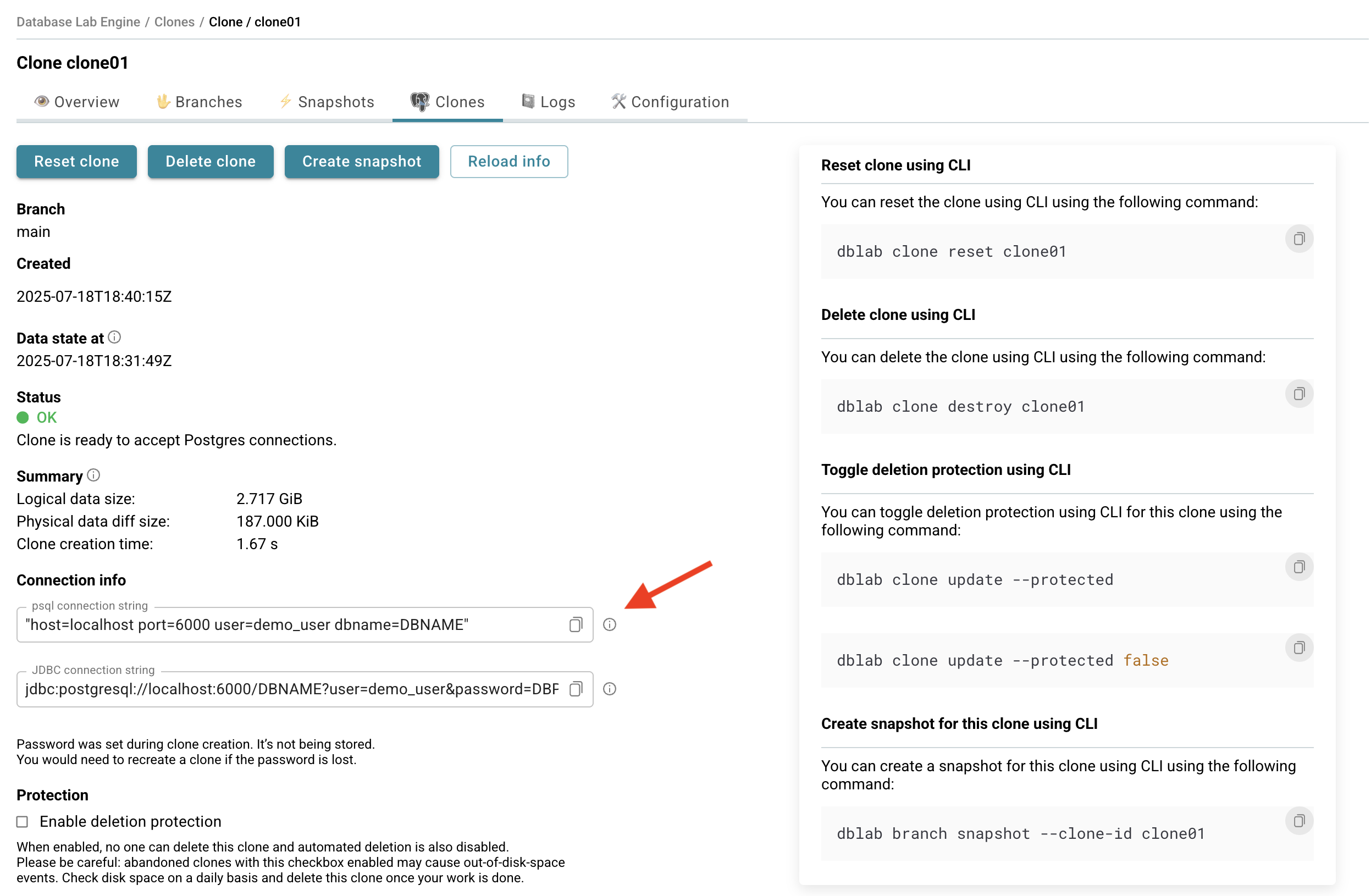
What you get
A clone in the DBLab UI, ready for connections 1.67 seconds after it was requested (a 2.7 GiB demo database). How it works
DBLab and Redgate Test Data Manager, side by side
| Question | DBLab | Redgate Test Data Manager |
|---|---|---|
| What it is | Open-source software that gives every developer, CI job and AI agent a writable, full-size copy of a PostgreSQL database in seconds. Thin clones share one physical copy of the data on one machine. docsdocs 2 | Test Data Manager gives "a masked and subsetted copy of your database, ready for dev and test", with anonymize and subset CLIs and a GUI. Redgate Clone creates disposable copies of databases, PostgreSQL among them, "for development and test". 182 |
| Which databases it can copy | YesAny PostgreSQL from version 10 up, wherever it runs. Managed services such as Amazon RDS, Aurora, Cloud SQL and Supabase are copied with dump and restore; self-managed servers can also be copied physically with WAL-G, pgBackRest or pg_basebackup. docsdocs 2 | YesAnonymize and subset connect to a database by connection string. Redgate Clone creates a data image from a backup file on an NFS or SMB share, or an empty one. PostgreSQL 16 and 17 backups were added in February 2026; version 11 support was removed in January 2025. 11216 |
| How a copy is made | Copy-on-write in the file system, with ZFS or LVM. Clones share unchanged blocks, so a clone takes extra disk space only for what it changes. docs | A data image is a point-in-time copy of the database files of a whole instance, restored from a backup. A data container is a shallow copy of a data image that stores only the file differences, running on a Kubernetes cluster. 101114 |
| Time to get a copy | A few seconds whatever the database size: under 2 seconds for a 10 TiB database with one user, up to 30 seconds with 15 users at once. The first copy of the source is slow; about 1 TiB an hour is a good speed. docsdocs 2 | Creating a data container takes no more than a few seconds and does not depend on database size. Creating a data image restores the backup, so it takes longer for larger backups; the docs we read give no PostgreSQL figure for it. 131110 |
| Data in a copy | YesThe whole database as of the chosen snapshot. Physical mode can follow the source continuously; logical mode is refreshed in full, on a schedule. docsdocs 2 | YesA data image holds the entire instance with all its databases, and each data container starts as an exact replica of it. Subsetting, which needs foreign key relationships, is a separate optional step. 10111 |
| Masking sensitive data | YesDocumented options: load an anonymized dump, or apply SQL transformations or PostgreSQL Anonymizer before snapshots are taken. You define the rules. docs | Yesrganonymize classifies columns that hold personal data, builds a masking file and masks the data, with deterministic masking available. On PostgreSQL the mask command needs a superuser or the table owner, to disable triggers and constraints, so Redgate advises running it on a copy, not production. 561 |
| CI and migration testing | YesDB Migration Checker runs pending migrations on a clone in CI, fails those that hold dangerous locks longer than a limit (10 seconds by default) and collects statistics. Any CI job can also create clones through the API or CLI. docs | YesThe rgclone CLI is meant to be scripted in DevOps pipelines, including clones per branch and CI pipeline. The TDM CLIs are documented for CI/CD and can run headless in Docker. The sources we reviewed do not describe migration testing. 871 |
| API, CLI and agent access | REST API, web UI and the dblab CLI. Joe, also available as pgai joe, returns EXPLAIN plans and timings from a clone, not rows. docsdocs 2docs 3 | The rgclone CLI for data images and containers; rganonymize and the subset CLI; a Test Data Manager GUI for Windows, with a Docker image in preview. The docs include prompts for AI coding tools. 9745 |
| Where it runs | YesOn a machine you control, in any cloud or on-premises. DBLab SE installs from the PostgresAI Console or AWS Marketplace. docsdocs 2 | YesSelf-hosted. Redgate Clone installs on an Ubuntu Server 22.04 or RHEL VM with an embedded Kubernetes cluster, or on Azure Kubernetes Service; a POC starts at 8 vCPUs and 16 GB RAM. The TDM GUI runs on Windows 10/11 or Windows Server 2016 or later; AWS users can deploy it with CloudFormation. 141543 |
| Open source | YesDBLab Engine is open source under Apache 2.0. docs | Not documentedNot documented in the sources we reviewed. Test Data Manager needs a license, and a free trial starts at sign-in. 1 |
| Documented limits | DBLab SE: 2,000 GiB per instance and a single user. All clones share one machine, and copy-on-write storage has different I/O performance, so timings on a clone should not be compared directly with production. docsdocs 2 | A PostgreSQL data container reserves 256Mi to 1Gi of RAM for its lifetime. Data images take about the same disk space as the uncompressed backup. Redgate recommends data containers live under a week. Subsetting needs foreign keys. 13111 |
| What you pay for | One machine and one physical copy of the data, however many clones run. DBLab SE is billed hourly by the size of that machine, not by database size or number of clones. docs | No public price in the sources we reviewed. The docs say a license is needed and offer a free trial. Clone capacity is bounded by RAM and disk: the FAQ estimates 13 to 15 concurrent containers, more realistically about 10, on 32 GB RAM and a 1 TB disk with data images under 100 GB. 11317 |
Pricing
| Product | Plan | List price | Notes |
|---|---|---|---|
| DBLab | DBLab Engine | Free | Open source, Apache 2.0; you run it |
| DBLab | DBLab SE | From $62/month | Billed hourly by machine size, plus your own cloud costs; 2,000 GiB limit; single user |
| DBLab | DBLab EE | Custom | Annual contract, from $0.2662 per 100 GiB per hour; unlimited database size, SSO |
| Redgate Test Data Manager | Redgate Test Data Manager | No public price | License required; free trial at sign-in 117 |
List prices on 18 Nov 2026. The billing units differ, so this is not a total-cost comparison. On 2026-11-18 the Test Data Manager product URL opened the SQL Provision page, and the Redgate product list did not name Test Data Manager or Redgate Clone. The documentation was still being updated: Test Data Manager had a release on 2026-11-12 and Redgate Clone on 2026-10-07. DBLab pricing
Using DBLab with Redgate Test Data Manager
Test Data Manager masks a PostgreSQL database in place, and DBLab can load an anonymized dump. A database masked with rganonymize can be dumped and used as the source for DBLab clones.
Questions
- Does Redgate Test Data Manager support PostgreSQL?
- Yes. The documentation lists PostgreSQL among the databases anonymize and subset work with. Redgate Clone lists PostgreSQL 11 to 17 on its engine support page; its release notes removed version 11 in January 2025 and added 16 and 17 in February 2026. 1916
- Where does Redgate Clone run?
- On infrastructure you run: an Ubuntu Server 22.04 or RHEL VM with an embedded Kubernetes cluster, or Azure Kubernetes Service. Backups are read from an NFS or SMB share; data images and containers live on disks attached to the cluster. 141512
Try a clone before you install anything
The public demo runs DBLab Engine: open it with the token demo-token, create a clone and connect to it. DBLab Engine is open source, so the next step is a machine of your own.
Sources
- Redgate Test Data Manager documentation
- Redgate Test Data Manager: architecture
- Redgate Test Data Manager: implementation checklist
- Redgate Test Data Manager: GUI installation
- Redgate Test Data Manager: anonymize a database with AI coding tools
- Redgate Test Data Manager: anonymization connection requirements
- Redgate Test Data Manager: command line interface
- Redgate Clone documentation
- Redgate Clone: database engine support
- Redgate Clone: data image
- Redgate Clone: data container
- Redgate Clone: data storage
- Redgate Clone: FAQ
- Redgate Clone: installing on VMs running Ubuntu or RHEL
- Redgate Clone: installation quick start guide
- Redgate Clone: release notes
- Redgate products
- Redgate Test Data Manager product URL
- Redgate Test Data Manager: release notes
These pages compare what each product does for PostgreSQL; other databases and the rest of the stack are out of scope. What we say about the other product comes from its own documentation, pricing page, changelog or source repository, read on the date shown; each row cites its source. "Not documented" means we did not find it in those sources, not that the product cannot do it. Prices are list prices and the billing units differ, so they are not a total-cost comparison. Product names are trademarks of their owners. Found a mistake? Tell us and we will correct the page.
More comparisons
- Delphixopen-source thin clones vs a test data platform
- Snapletfull-size clones vs seed and subset (closed 2024)
- Tonic.aithin clones vs de-identified database copies
- Amazon Aurora cloningclones of any Postgres vs Aurora clusters
- Amazon RDS Blue/Green Deploymentstest clones vs a switchover
- Amazon RDS snapshot restorethin clones vs a new instance each
- Ardentself-hosted thin clones vs a replicated branch service
- Cloud SQL cloningthin clones vs a new Cloud SQL instance
- All comparisons