PostgresAI vs SolarWinds DPA
open source vs commercial wait-time analysis
SolarWinds DPA is self-hosted, agentless wait-time analysis with table and index advisors, sold by quote. PostgresAI is open source with a list price per cluster.
Where PostgresAI is ahead of SolarWinds DPA
Each point pairs what our documentation says with what the SolarWinds DPA documentation says. Follow the links and check.
Open source, no licence fee to self-host
PostgresAIThe monitoring software is open source under Apache 2.0, so self-hosting it carries no licence fee. docsdocs 2
SolarWinds DPASolarWinds DPA needs a subscription license for each monitored database instance; if a subscription is not renewed, DPA keeps historical data but stops collecting new data. The sources we reviewed do not describe DPA as open source. 7
A published price per cluster
PostgresAIStarter is $16 per cluster a month. Scale is $512 per cluster a month and covers a primary and up to 5 replicas. Self-hosting the open-source software carries no licence fee. docs
13 months of history
PostgresAIScale keeps 13 months of history. docs
SolarWinds DPASolarWinds DPA keeps detailed chart data for a shorter period, typically 30 days. Reports summarize the previous 90 days by hour and older data by day, for five years. 12
Test the fix on a full-size copy first
Short answer
SolarWinds Database Performance Analyzer (DPA) is self-hosted, agentless software that analyzes PostgreSQL by wait time, with table and index advisors, anomaly detection and AI Query Assist. PostgresAI monitors PostgreSQL, runs scheduled checkups and turns findings into Issues that you, your AI agent or a PostgresAI expert can act on. Pick DPA if you want wait-time analysis on servers you run, with years of summarized history. Pick PostgresAI if you want open-source monitoring, public prices, agent access through MCP or human experts.
When SolarWinds DPA is the better choice
- Wait-time analysis is the core of the product: it ranks statements by the time users and applications wait, and flags hours when wait time is higher than predicted.
- Self-hosted and agentless: the DPA server and its repository database run on servers you control, and SolarWinds says DPA uses less than one percent of database resources.
- Table advisors flag PostgreSQL tables that had inefficient queries each day, index advisors flag missing indexes, and with pgstattuple a table advisor shows an index bloat percentage.
- Reports keep wait-time data summarized by day for five years.
- Covers self-managed PostgreSQL and EDB Postgres as well as Amazon RDS, Aurora, Azure Database for PostgreSQL Flexible Server and Cloud SQL.
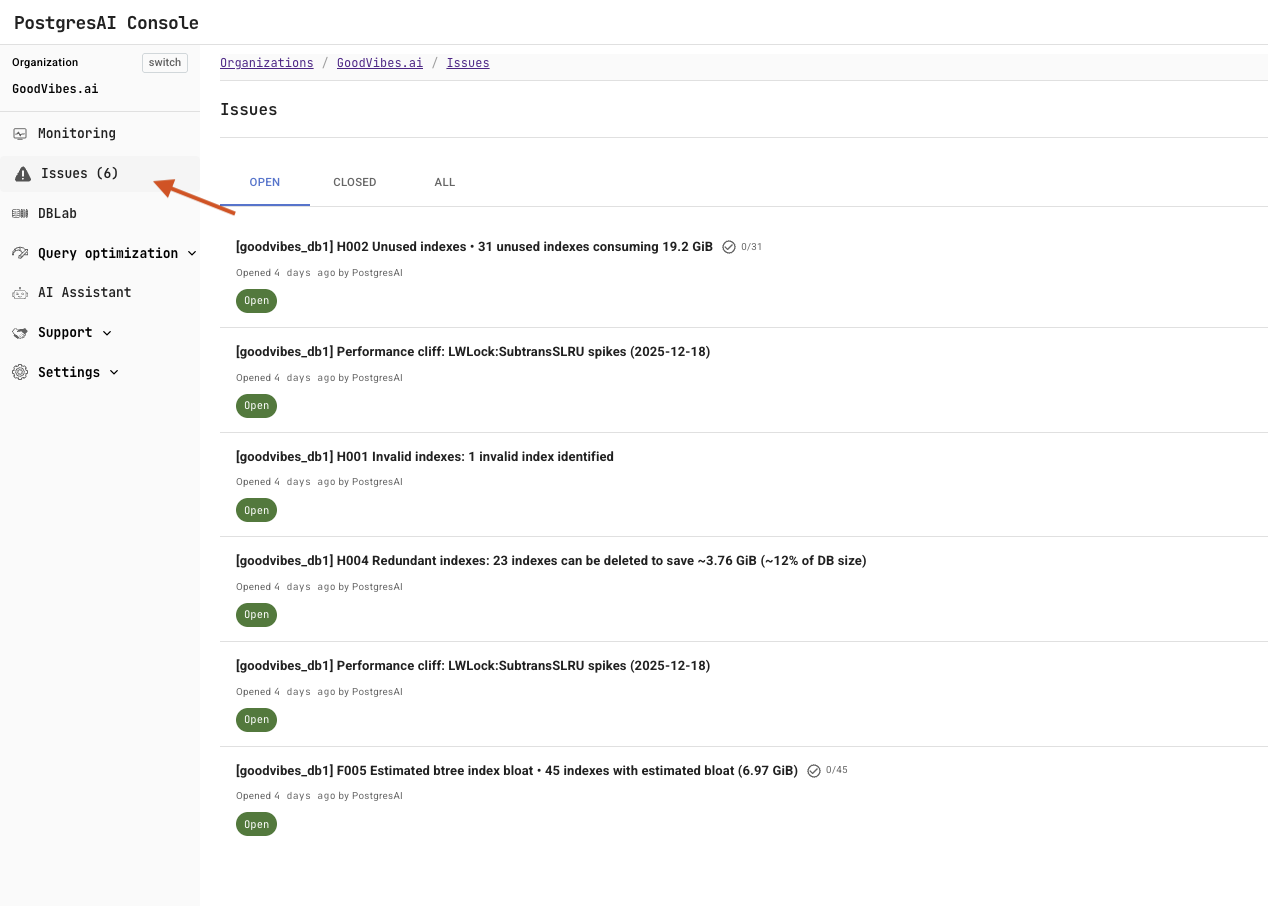
What you get
Checkup findings as Issues in the PostgresAI Console. How it works
PostgresAI and SolarWinds DPA, side by side
| Question | PostgresAI | SolarWinds DPA |
|---|---|---|
| What it is | PostgreSQL monitoring with scheduled health checkups. Findings become Issues with severity, evidence and a recommended fix, which you, your AI agent or a PostgresAI expert can act on. docsdocs 2 | Self-hosted database performance monitoring that supports PostgreSQL. It focuses on application and end-user wait time rather than health metrics, and adds table and index advisors, wait time anomaly detection, alerts and AI Query Assist. 194 |
| Where your Postgres can run, and which versions | YesAmazon RDS and Aurora, Google Cloud SQL, Azure Database for PostgreSQL, Supabase, Tiger Data, self-managed servers and Postgres running on Kubernetes. PostgreSQL 14 and newer, with the pg_stat_statements extension. docs | YesSelf-managed PostgreSQL 14 to 18, EDB Postgres 14 to 16, Amazon RDS for PostgreSQL 14 to 17, Aurora PostgreSQL 14 to 16, Azure Database for PostgreSQL Flexible Server 14 to 17 and Cloud SQL for PostgreSQL 14 to 17. Complete monitoring needs pg_stat_statements; limited monitoring reads pg_stat_activity only. 210 |
| Where it runs and what it collects | YesHosted by PostgresAI, or self-hosted in your own cloud account or on your own server. It collects database metadata such as statistics, normalized query texts and wait events, not table data or query parameters. docsdocs 2 | YesSelf-hosted and agentless: the DPA server runs on Windows Server 2022 or 2025 or Linux, or from AWS and Azure Marketplace images, and stores collected data in a separate repository database. SolarWinds Observability SaaS, a separate SaaS product, also monitors PostgreSQL on dedicated hosts, RDS, Aurora, Cloud SQL and Azure. 3914 |
| Open source | YesThe monitoring software is open source under Apache 2.0. Hosted plans are a separate paid service. docsdocs 2 | Not documentedNot documented in the sources we reviewed. DPA is sold with subscription licenses per monitored database instance. 7 |
| Query performance analysis | YesTop queries from pg_stat_statements by calls, execution time, planning time and rows, with a drill-down dashboard for a single query. For execution plans, Joe runs EXPLAIN on a DBLab clone. docsdocs 2 | YesWait time per SQL statement, with complete SQL text and execution statistics from pg_stat_statements in complete mode, and a Query Details page per query. AI Query Assist sends a query and its captured plan, with personal data masked, to an LLM for tuning suggestions. 1046 |
| Wait event analysis | YesAn ASH-style wait event dashboard built from samples of pg_stat_activity. No extra extension is needed. docs | YesWait-based analysis is the core of DPA: it ranks the issues causing the most wait time. For PostgreSQL, limited mode reads pg_stat_activity only, and complete mode adds pg_stat_statements. The sources we reviewed do not state the sampling interval. 910 |
| Health checks and recommendations | YesScheduled checkup reports on settings, autovacuum and bloat, and indexes (invalid, unused, redundant). Each finding becomes an Issue with severity, evidence and a specific fix. docsdocs 2 | YesTable advisors, available for PostgreSQL, list tables that had inefficient queries each day; index advisors flag missing indexes, and for PostgreSQL the pgstattuple extension lets a table advisor show an index bloat percentage. Anomaly detection flags hours when wait time is higher than predicted. 54108 |
| AI and agent access | YesThe postgresai CLI (alias pgai) and an MCP server with tools for Issues, action items and checkup reports. The setup guide covers Cursor, Claude Code, Windsurf and Codex. docsdocs 2 | Not documentedNot documented in the sources we reviewed. AI Query Assist, for PostgreSQL queries among others, sends a query and its plan through SolarWinds Observability SaaS to an LLM for tuning suggestions, up to four requests per instance in 24 hours; it is not an interface for AI agents. 61 |
| Testing a fix before production | YesWith DBLab Engine, a separate open-source product: a full-size thin clone of the database in seconds, where an index or query change can be run on real data. DBLab is set up and priced separately. docsdocs 2 | Not documentedNot documented in the sources we reviewed. Table advisors and AI Query Assist suggest changes; the sources do not describe running a change on a separate copy of the data. 56 |
| Human PostgreSQL experts | YesScale includes two expert requests a month, answered within 24 business hours. Either plan can buy a one-off pack of two requests for $500. Consulting is separate. docsdocs 2 | Not documentedNot documented in the sources we reviewed. The product page describes expert tuning advisors in the software, not PostgreSQL consulting. 1 |
| Alerts | Email and Slack alerts on Starter and Scale. docs | Wait time, resource, administrative and custom SQL alerts, including a wait time anomaly alert, sent by email or as SNMP traps. DPA recommends an execution interval of at least 10 minutes. 1116 |
| History kept | 14 days on Starter, 13 months on Scale, custom on Enterprise. docs | Reports summarize the previous 90 days by hour and older data by day, available for five years. Detailed chart data is kept for a shorter period, typically 30 days. 12 |
| Security attestations | SOC 2 Type 2 examination completed for the Security and Availability criteria, covering March 4 to June 4, 2026. The SOC 3 report is public. docs | DPA is self-hosted. The SolarWinds Trust Center lists ISO/IEC 27001:2022 for the ISMS supporting SolarWinds products and services, and SOC 2 Type 2 reports for Pingdom, Loggly, Service Desk and Observability SaaS. The sources we reviewed do not describe a SOC 2 report for DPA. 13 |
Pricing
| Product | Plan | List price | Notes |
|---|---|---|---|
| PostgresAI | Starter | $16 per cluster/month | Primary only, 14-day retention, no expert requests included |
| PostgresAI | Scale | $512 per cluster/month | Primary and up to 5 replicas in one cluster, 13-month retention, Grafana dashboards, 2 expert requests a month |
| PostgresAI | Enterprise | Custom | Contact sales |
| PostgresAI | Self-hosted | No licence fee | Open source under Apache 2.0; you run it yourself |
| SolarWinds DPA | DPA subscription | Quote | One license per monitored database instance; the DPA entry on the SolarWinds pricing page shows no price; 14-day free trial 1715 |
| SolarWinds DPA | AWS Marketplace | Metered hourly | Billed through Amazon by the number of database instances monitored each hour; prices are on AWS Marketplace 7 |
List prices on 18 Nov 2026. The billing units differ, so this is not a total-cost comparison. A lapsed subscription keeps historical data but stops new collection. You can register more instances than you have licenses for. PostgresAI pricing
Using PostgresAI with SolarWinds DPA
DBLab is a separate product that copies any PostgreSQL source, so a team that monitors with DPA can still use a DBLab clone to try an index or query change on full-size data before production.
Questions
- Does SolarWinds DPA support PostgreSQL?
- Yes. DPA lists self-managed PostgreSQL 14 to 18 and EDB Postgres, Amazon RDS and Aurora, Azure Database for PostgreSQL Flexible Server and Cloud SQL for PostgreSQL. Table and index advisors need complete monitoring, which reads pg_stat_statements. 210
- Is SolarWinds DPA available as SaaS?
- DPA itself is self-hosted on Windows or Linux, or from AWS and Azure Marketplace images. SolarWinds Observability SaaS is a separate SaaS product that also monitors PostgreSQL. 314
- What does SolarWinds DPA cost?
- The DPA entry on the SolarWinds pricing page shows no price; DPA is licensed per monitored database instance with subscription licenses, offered by quote, with a 14-day free trial. On AWS Marketplace it is metered by the number of instances monitored each hour. 1715
- Can I use PostgresAI and SolarWinds DPA together?
- Yes. DBLab, the PostgresAI cloning product, copies any PostgreSQL source, so a team that monitors with DPA can test an index or query change on a full-size DBLab clone before production.
Check it on your own database
The express checkup works with PostgreSQL 14 or newer. With --no-upload it needs no account and sends no report data to PostgresAI. It needs Node.js 18 or newer and a database role with pg_monitor. Compare what it finds with what your current tool shows for the same database.
Sources
- SolarWinds Database Performance Analyzer
- DPA documentation: database instances DPA can monitor
- DPA documentation: system requirements
- DPA administrator guide
- DPA documentation: table tuning advisors
- DPA documentation: AI Query Assist
- DPA documentation: licensing model
- DPA documentation: find and investigate anomalies
- DPA documentation: wait-based monitoring
- DPA documentation: register a PostgreSQL instance
- DPA documentation: wait time alerts
- DPA documentation: about reports
- SolarWinds Trust Center
- SolarWinds Observability SaaS: monitor PostgreSQL
- SolarWinds pricing
- DPA documentation: alert categories and types
These pages compare what each product does for PostgreSQL; other databases and the rest of the stack are out of scope. What we say about the other product comes from its own documentation, pricing page, changelog or source repository, read on the date shown; each row cites its source. "Not documented" means we did not find it in those sources, not that the product cannot do it. Prices are list prices and the billing units differ, so they are not a total-cost comparison. Product names are trademarks of their owners. Found a mistake? Tell us and we will correct the page.
More comparisons
- CorootPostgres experts and history vs eBPF query capture
- Datadog Database Monitoringopen source vs traced queries
- Dynatraceopen-source monitoring vs an ActiveGate extension
- Foglight for PostgreSQLopen source vs workload drill-down
- Grafana Cloud Database Observabilitycheckups vs query data
- Netdatawait events and experts vs per-second metrics
- New Relicopen source with experts vs queries tied to traces
- Redgate Monitoropen source vs captured plans and alerts
- All comparisons