PostgresAI vs Datasentinel
open source with fixes vs session and plan data
Datasentinel samples sessions every 10 seconds and keeps per-plan statistics, on-premises or SaaS. PostgresAI is open source and files findings as Issues with a fix.
Where PostgresAI is ahead of Datasentinel
Each point pairs what our documentation says with what the Datasentinel documentation says. Follow the links and check.
Open source, no licence fee to self-host
A published price per cluster
PostgresAIStarter is $16 per cluster a month. Scale is $512 per cluster a month and covers a primary and up to 5 replicas. Self-hosting the open-source software carries no licence fee. docs
Every finding comes with a fix
Test the fix on a full-size copy first
PostgresAIWith DBLab Engine, a separate open-source product, an index or query change runs on a full-size thin clone of the database, created in seconds, before it reaches production. docsdocs 2
DatasentinelThe Datasentinel AI Connector compare command compares two time windows on the same instance, for example before and after a release. The sources we reviewed do not describe trying a change on a copy of the database. 11
Short answer
Datasentinel is a commercial PostgreSQL performance monitoring platform, run on-premises or as SaaS. It samples active sessions every 10 seconds, collects query statistics and execution plans every minute, and since release 2026.10 offers AI Connector, an MCP server and Skill sold as an add-on. PostgresAI monitors Postgres, runs scheduled checkups and turns findings into Issues that you, your AI agent or a PostgresAI expert can act on. Pick Datasentinel for per-plan runtime statistics, 10-second session history and a large fleet on your own servers. Pick PostgresAI for open-source monitoring you can self-host with no licence fee, published prices, or human experts on the plan.
When Datasentinel is the better choice
- Execution plans are collected every minute with runtime statistics per plan, through Datasentinel's fork of pg_store_plans, so plan changes over time are visible.
- Active sessions are sampled every 10 seconds, with wait event type, wait event, application, client, user and query as filterable tags.
- AI Connector, released in 2026.10, lets Claude, ChatGPT, Copilot, Cursor and other MCP clients query the metrics read-only, with OAuth 2.1 sign-in and the same role-based access as the web interface.
- Agentless monitoring covers Amazon RDS and Aurora, Google Cloud SQL and AlloyDB, Azure, Kubernetes and Docker, and works with PostgreSQL 9.4 and newer.
- Live360 connects to an instance in real time to show current sessions and blocking chains, and can terminate a session for users with the right privilege.
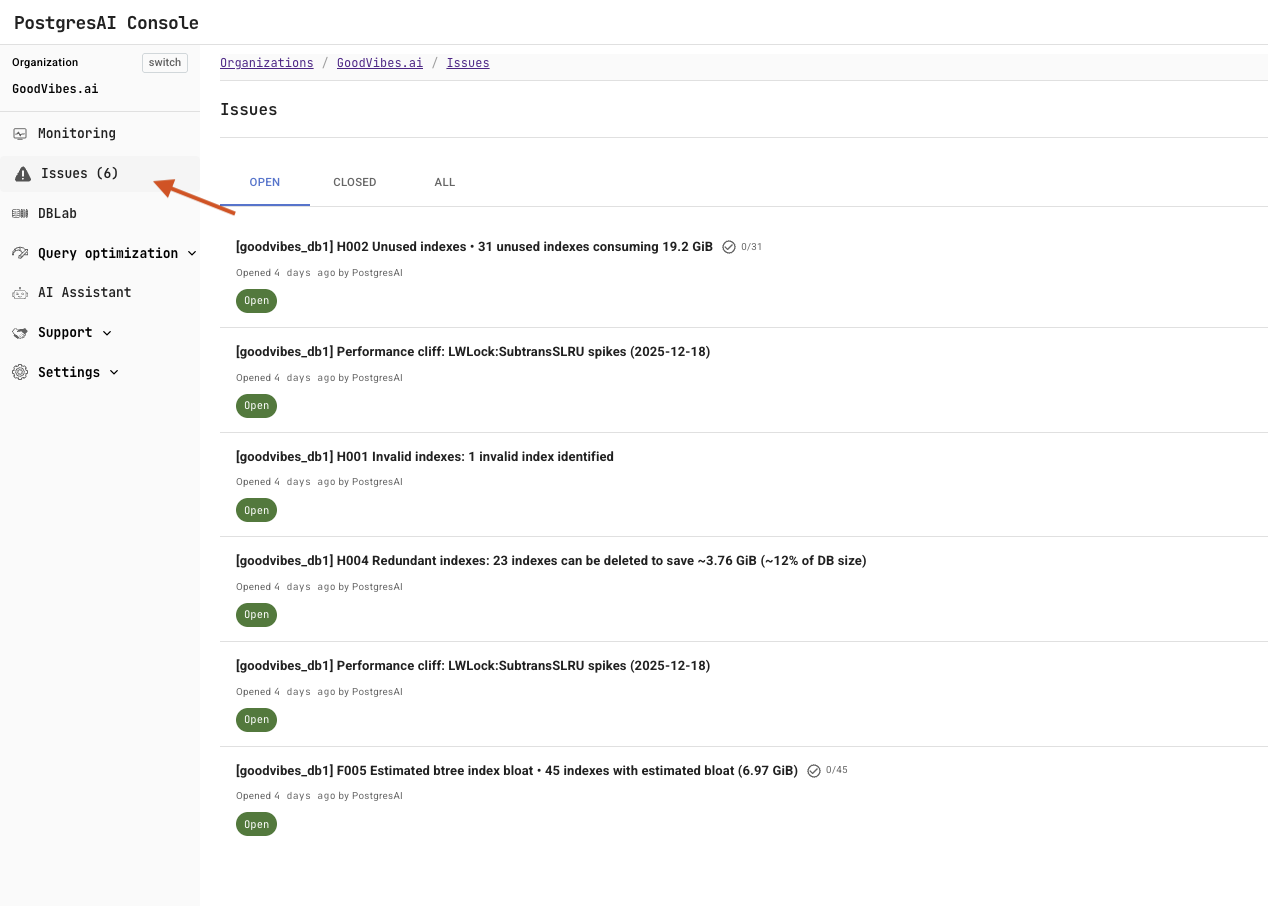
What you get
Checkup findings as Issues in the PostgresAI Console. How it works
PostgresAI and Datasentinel, side by side
| Question | PostgresAI | Datasentinel |
|---|---|---|
| What it is | PostgreSQL monitoring with scheduled health checkups. Findings become Issues with severity, evidence and a recommended fix, which you, your AI agent or a PostgresAI expert can act on. docsdocs 2 | A PostgreSQL performance monitoring platform: Session History, Top Queries, Top Tables, Lock Explorer, cluster and system metrics, Live360, PDF reports and alerting. The platform bundles InfluxDB for metrics and a Grafana-based interface. 12 |
| Where your Postgres can run, and which versions | YesAmazon RDS and Aurora, Google Cloud SQL, Azure Database for PostgreSQL, Supabase, Tiger Data, self-managed servers and Postgres running on Kubernetes. PostgreSQL 14 and newer, with the pg_stat_statements extension. docs | YesLocal agents on self-managed hosts, or agentless monitoring for Amazon RDS and Aurora, Google Cloud SQL and AlloyDB, Azure, Kubernetes, Docker and other managed services. Monitored clusters need PostgreSQL 9.4 or newer and pg_stat_statements. Agentless setups get no OS metrics unless the system_stats extension is installed. 26 |
| Where it runs and what it collects | YesHosted by PostgresAI, or self-hosted in your own cloud account or on your own server. It collects database metadata such as statistics, normalized query texts and wait events, not table data or query parameters. docsdocs 2 | YesOn-premises on a dedicated machine you run, or SaaS on a dedicated machine hosted by Datasentinel with agents on your side. A read-only internal function adds column and extended statistics without SELECT on application tables, and never returns table contents. 212 |
| Open source | YesThe monitoring software is open source under Apache 2.0. Hosted plans are a separate paid service. docsdocs 2 | PartlyDatasentinel is commercial software on an annual subscription. Datasentinel publishes open-source PostgreSQL extensions: pg_datasentinel and its fork of pg_store_plans, used for plan collection. The sources we reviewed do not describe the platform's source code as public. 10113 |
| Query performance analysis | YesTop queries from pg_stat_statements by calls, execution time, planning time and rows, with a drill-down dashboard for a single query. For execution plans, Joe runs EXPLAIN on a DBLab clone. docsdocs 2 | YesStatistics for all queries every minute, ranked by time, calls, rows, buffers, temp I/O, read and write time or WAL. Execution plans and their runtime metrics are collected every minute and shown as text or a tree, per query over time. 45 |
| Wait event analysis | YesAn ASH-style wait event dashboard built from samples of pg_stat_activity. No extra extension is needed. docs | YesSession History samples pg_stat_activity every 10 seconds and tags each sample with wait_event_type and wait_event, so load can be broken down by wait, query, user or application. 3 |
| Health checks and recommendations | YesScheduled checkup reports on settings, autovacuum and bloat, and indexes (invalid, unused, redundant). Each finding becomes an Issue with severity, evidence and a specific fix. docsdocs 2 | PartlyChanged parameters are checked hourly and alert rules cover connections, blocking, WAL, archiving and replication. Advice on bloat, missing or unused indexes, autovacuum and settings comes from AI Connector commands, a licensed add-on. 1871198 |
| AI and agent access | YesThe postgresai CLI (alias pgai) and an MCP server with tools for Issues, action items and checkup reports. The setup guide covers Cursor, Claude Code, Windsurf and Codex. docsdocs 2 | YesAI Connector, released in 2026.10 on November 2, 2026: an MCP server on each platform server plus a Skill, with guides for Claude Code, Codex, Copilot, Cursor, VS Code, ChatGPT and Gemini. It is read-only and licensed as an add-on. A REST API is also documented. 8919 |
| Testing a fix before production | YesWith DBLab Engine, a separate open-source product: a full-size thin clone of the database in seconds, where an index or query change can be run on real data. DBLab is set up and priced separately. docsdocs 2 | Not documentedThe AI Connector compare command compares two time windows, for example before and after a release. The sources we reviewed do not describe trying a change on a copy before production. 11 |
| Human PostgreSQL experts | YesScale includes two expert requests a month, answered within 24 business hours. Either plan can buy a one-off pack of two requests for $500. Consulting is separate. docsdocs 2 | PartlyProduct support by email, with remote support over video conference if needed. The sources we reviewed do not describe PostgreSQL consulting. 14 |
| Alerts | Email and Slack alerts on Starter and Scale. docs | Off by default. Templates assigned by tag set WARNING and CRITICAL thresholds for instance status, connections, blocked sessions, WAL, archiving, replication lag and host metrics, checked every minute. Notifications go to email, webhooks or a custom script. 177 |
| History kept | 14 days on Starter, 13 months on Scale, custom on Enterprise. docs | 14 days by default, adjustable in Global Settings. Each platform has its own retention period. 15 |
| Security attestations | SOC 2 Type 2 examination completed for the Security and Availability criteria, covering March 4 to June 4, 2026. The SOC 3 report is public. docs | The sources we reviewed do not describe SOC 2 or ISO 27001 attestations. On-premises installs keep all metrics on your own machine. 12 |
Pricing
| Product | Plan | List price | Notes |
|---|---|---|---|
| PostgresAI | Starter | $16 per cluster/month | Primary only, 14-day retention, no expert requests included |
| PostgresAI | Scale | $512 per cluster/month | Primary and up to 5 replicas in one cluster, 13-month retention, Grafana dashboards, 2 expert requests a month |
| PostgresAI | Enterprise | Custom | Contact sales |
| PostgresAI | Self-hosted | No licence fee | Open source under Apache 2.0; you run it yourself |
| Datasentinel | Subscription | No public price | Annual subscription priced by the number of PostgreSQL instances; contact sales 10 |
| Datasentinel | AI Connector | No public price | Add-on enabled by a licence token for the whole installation 8 |
| Datasentinel | Free trial | Free for 60 days | On-premises or SaaS, no limit on the number of clusters 16 |
List prices on 18 Nov 2026. The billing units differ, so this is not a total-cost comparison. PostgresAI pricing
Using PostgresAI with Datasentinel
DBLab is a separate product that copies any PostgreSQL source, so a team that monitors with Datasentinel can still use a DBLab clone to try an index or query change on full-size data before production.
Questions
- Is Datasentinel open source?
- Datasentinel is commercial software licensed by annual subscription, and the sources we reviewed do not describe the platform's source code as public. Its open-source PostgreSQL extensions, pg_datasentinel and a fork of pg_store_plans, are on GitHub. PostgresAI monitoring is open source under Apache 2.0. 10113
- Does Datasentinel work with Amazon RDS?
- Yes. Agentless monitoring connects remotely to Amazon RDS and Aurora, Google Cloud SQL and AlloyDB, and Azure. Host metrics such as CPU and memory need the system_stats extension in that mode. 6
- What does Datasentinel cost?
- The pricing page we reviewed shows no amount. Datasentinel is sold by annual subscription priced by the number of PostgreSQL instances, and AI Connector is a separate add-on. A 60-day free trial is available on-premises or as SaaS. 10816
- What is Datasentinel AI Connector, and is it generally available?
- It is an MCP server plus a Skill that let an AI assistant read Datasentinel metrics and return findings with recommendations, read-only. It shipped in release 2026.10 on November 2, 2026, as a licensed add-on; the changelog does not mark it as preview. 98
- Can I use PostgresAI and Datasentinel together?
- Yes. DBLab, the PostgresAI cloning product, copies any PostgreSQL source, so a team that monitors with Datasentinel can test an index or query change on a full-size DBLab clone before production.
Check it on your own database
The express checkup works with PostgreSQL 14 or newer. With --no-upload it needs no account and sends no report data to PostgresAI. It needs Node.js 18 or newer and a database role with pg_monitor. Compare what it finds with what your current tool shows for the same database.
Sources
- Datasentinel home page
- Datasentinel documentation: architecture
- Datasentinel documentation: Session History
- Datasentinel documentation: Top Queries
- Datasentinel documentation: execution plans
- Datasentinel documentation: agentless monitoring
- Datasentinel documentation: alerting templates
- Datasentinel changelog
- Datasentinel documentation: AI Connector
- Datasentinel documentation: welcome and licensing
- Datasentinel documentation: Skill commands reference
- Datasentinel documentation: internal function
- Datasentinel pg_store_plans repository
- Datasentinel documentation: how to contact us
- Datasentinel documentation: platform FAQ
- Datasentinel documentation: free trial
- Datasentinel documentation: alerting settings
- Datasentinel documentation: changed parameters
- Datasentinel documentation: automate with the API
These pages compare what each product does for PostgreSQL; other databases and the rest of the stack are out of scope. What we say about the other product comes from its own documentation, pricing page, changelog or source repository, read on the date shown; each row cites its source. "Not documented" means we did not find it in those sources, not that the product cannot do it. Prices are list prices and the billing units differ, so they are not a total-cost comparison. Product names are trademarks of their owners. Found a mistake? Tell us and we will correct the page.
More comparisons
- EDB Postgres Enterprise Managerany Postgres vs EDB fleets
- pganalyzeopen source vs plan and log insights
- pgDashopen source with wait events vs pgmetrics reports
- pgEdge AI DBA Workbenchhuman experts vs an AI assistant
- pgMustardwhole-database monitoring vs one plan at a time
- Amazon DevOps Guru for RDSany cloud vs ML on RDS (closing)
- Azure PostgreSQL built-in toolsany provider vs Azure only
- Cloud SQL Query Insightsany provider vs inside Cloud SQL
- All comparisons