PostgresAI vs pgMustard
whole-database monitoring vs one plan at a time
pgMustard reviews one EXPLAIN ANALYZE plan at a time and scores tips by time saved. PostgresAI monitors the whole database and files findings as Issues with a fix.
Where PostgresAI is ahead of pgMustard
Each point pairs what our documentation says with what the pgMustard documentation says. Follow the links and check.
Open source, no licence fee to self-host
PostgresAIThe monitoring software is open source under Apache 2.0, so self-hosting it carries no licence fee. docsdocs 2
pgMustardpgMustard is a hosted web app sold as an annual subscription, from 95 EUR a year. Its pricing FAQ says there is currently no on-premise option. 2
Test the fix on a full-size copy first
PostgresAIWith DBLab Engine, a separate open-source product, an index or query change runs on a full-size thin clone of the database, created in seconds, before it reaches production. docsdocs 2
pgMustardpgMustard reviews EXPLAIN ANALYZE output that you produce on your own database. Its docs note that the analyze parameter causes the query to be executed, so to be aware of that for data-modifying and long-running queries. 3
Every finding comes with a fix
An AI agent can work through the findings
Short answer
The two are different kinds of tool. pgMustard reviews a single EXPLAIN ANALYZE plan that you paste into the web app or send to its API, scores tips 0 to 5 by estimated time saved and highlights the best three. PostgresAI monitors Postgres continuously, runs scheduled checkups and turns findings into Issues that you, your AI agent or a PostgresAI expert can act on. Pick pgMustard when you already know which query is slow and want help reading its plan, from 95 EUR a year. Pick PostgresAI to find the slow queries and other problems across a database. The two can be used together.
When pgMustard is the better choice
- Focused on one job: reading an EXPLAIN ANALYZE plan, with per-operation timings, a timing bar and 17 kinds of tips, such as index potential, bad row estimates, operations on disk and JIT.
- Needs no access to your database: you paste TEXT or JSON plans from PostgreSQL 9.6 to 18, and plans are not stored server-side unless you opt in.
- A score endpoint returns tips and scores as JSON, documented for CI checks such as failing a test when an index tip scores 5.0.
- Pro costs 95 EUR a year for one user with unlimited plan reviews, and the trial covers five of your own plans with no time limit.
- The founder offers Postgres consulting, including performance work and health checks.
What you get
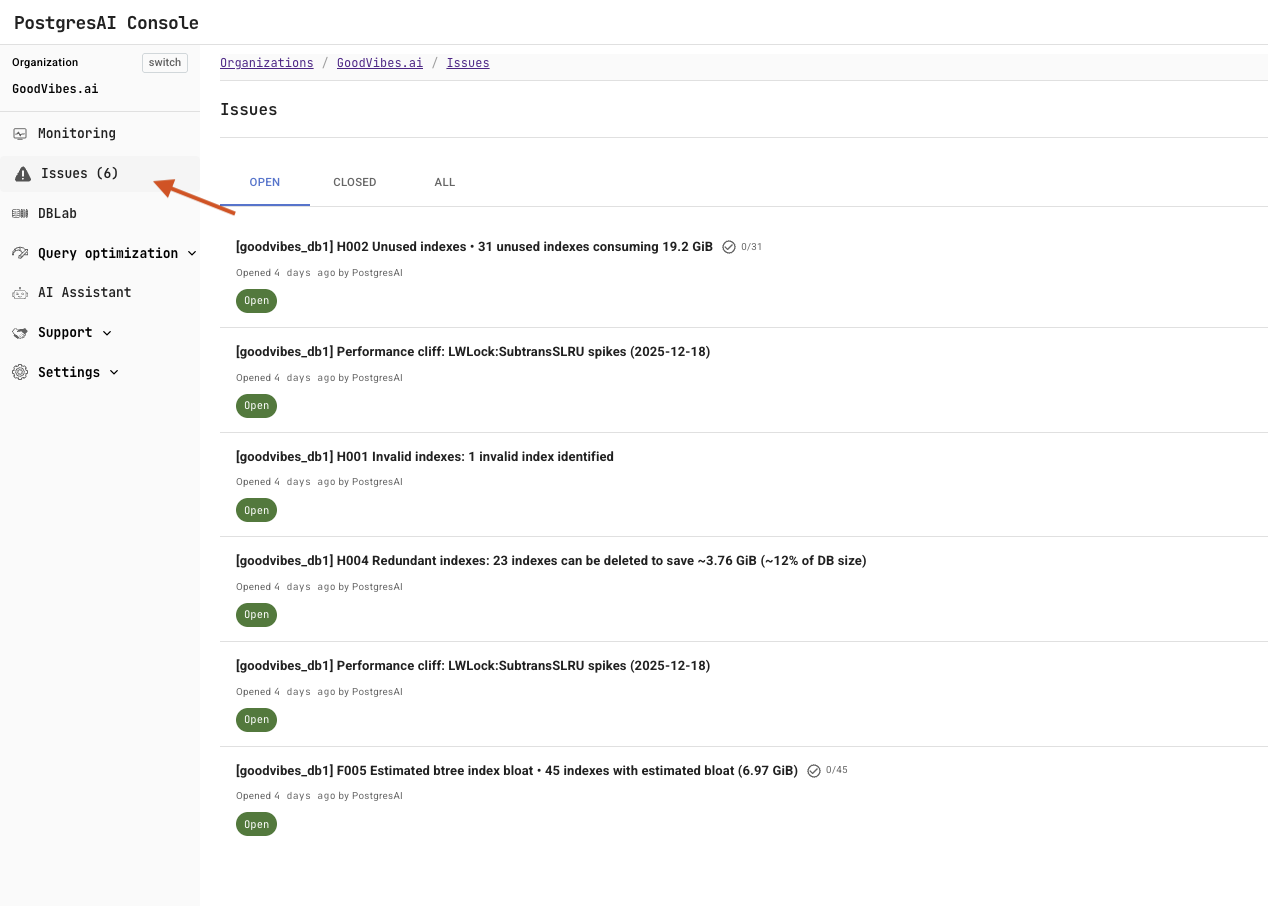
Checkup findings as Issues in the PostgresAI Console. How it works
PostgresAI and pgMustard, side by side
| Question | PostgresAI | pgMustard |
|---|---|---|
| What it is | PostgreSQL monitoring with scheduled health checkups. Findings become Issues with severity, evidence and a recommended fix, which you, your AI agent or a PostgresAI expert can act on. docsdocs 2 | A web tool that reviews PostgreSQL query plans. You submit EXPLAIN ANALYZE output; it shows a timing bar and an operation tree and scores tips from 0 to 5 by estimated time saving, highlighting the best three. The sources we reviewed do not describe connecting to or monitoring a database. 13 |
| Where your Postgres can run, and which versions | YesAmazon RDS and Aurora, Google Cloud SQL, Azure Database for PostgreSQL, Supabase, Tiger Data, self-managed servers and Postgres running on Kubernetes. PostgreSQL 14 and newer, with the pg_stat_statements extension. docs | Does not applyDoes not apply: pgMustard reads plans you paste or send, so where the database runs does not matter as long as you can run EXPLAIN ANALYZE and copy the output. 3 |
| Where it runs and what it collects | YesHosted by PostgresAI, or self-hosted in your own cloud account or on your own server. It collects database metadata such as statistics, normalized query texts and wait events, not table data or query parameters. docsdocs 2 | NoHosted only; the pricing FAQ says there is no on-premise option. Plans are processed in Google Cloud in Finland and are not stored unless you opt in, save or publish them. Sign-in is with a GitHub or Google account. 273 |
| Open source | YesThe monitoring software is open source under Apache 2.0. Hosted plans are a separate paid service. docsdocs 2 | Not documentedNot documented in the sources we reviewed. pgMustard is sold as a paid annual subscription. 2 |
| Query performance analysis | YesTop queries from pg_stat_statements by calls, execution time, planning time and rows, with a drill-down dashboard for a single query. For execution plans, Joe runs EXPLAIN on a DBLab clone. docsdocs 2 | YesAnalysis of one plan at a time: per-operation timings and rows, taking loops, threads, subplans and CTEs into account, and tips such as index potential, poor index efficiency, operations on disk and excessive planning time. The sources we reviewed do not describe collecting workload statistics. 13 |
| Wait event analysis | YesAn ASH-style wait event dashboard built from samples of pg_stat_activity. No extra extension is needed. docs | Does not applyDoes not apply: pgMustard analyzes plans you submit; the sources we reviewed do not describe sampling sessions on a database. 3 |
| Health checks and recommendations | YesScheduled checkup reports on settings, autovacuum and bloat, and indexes (invalid, unused, redundant). Each finding becomes an Issue with severity, evidence and a specific fix. docsdocs 2 | Does not applyDoes not apply to the product, which reviews single query plans. Health checks of a database are offered as consulting by the founder. 36 |
| AI and agent access | YesThe postgresai CLI (alias pgai) and an MCP server with tools for Issues, action items and checkup reports. The setup guide covers Cursor, Claude Code, Windsurf and Codex. docsdocs 2 | PartlyA REST API with a score endpoint, returning tips and scores as JSON, and a save endpoint, returning a URL. It needs a paid plan and uses credits, 1,000 a year on Pro. The sources we reviewed do not describe an MCP server. 4235 |
| Testing a fix before production | YesWith DBLab Engine, a separate open-source product: a full-size thin clone of the database in seconds, where an index or query change can be run on real data. DBLab is set up and priced separately. docsdocs 2 | PartlyThe score endpoint is documented for automated performance testing, for example failing a test when an index tip scores 5.0. It scores plans from whatever database you ran them on; the sources we reviewed do not describe providing a copy of the data. 4 |
| Human PostgreSQL experts | YesScale includes two expert requests a month, answered within 24 business hours. Either plan can buy a one-off pack of two requests for $500. Consulting is separate. docsdocs 2 | YesThe founder, Michael Christofides, offers Postgres consulting on performance, health checks and reliability, aimed at small teams without a DBA. 6 |
| Alerts | Email and Slack alerts on Starter and Scale. docs | The sources we reviewed do not describe alerts: pgMustard analyzes plans on request. 13 |
| History kept | 14 days on Starter, 13 months on Scale, custom on Enterprise. docs | Plans are not stored server-side unless you opt in. The 20 most recent plans are kept in browser local storage; paid plans include unlimited saved plans. 32 |
| Security attestations | SOC 2 Type 2 examination completed for the Security and Availability criteria, covering March 4 to June 4, 2026. The SOC 3 report is public. docs | The privacy policy, updated 15 October 2026, says plans are processed in Google Cloud in Finland and not logged. The sources we reviewed do not describe SOC 2 or ISO 27001 attestations. 7 |
Pricing
| Product | Plan | List price | Notes |
|---|---|---|---|
| PostgresAI | Starter | $16 per cluster/month | Primary only, 14-day retention, no expert requests included |
| PostgresAI | Scale | $512 per cluster/month | Primary and up to 5 replicas in one cluster, 13-month retention, Grafana dashboards, 2 expert requests a month |
| PostgresAI | Enterprise | Custom | Contact sales |
| PostgresAI | Self-hosted | No licence fee | Open source under Apache 2.0; you run it yourself |
| pgMustard | Pro | 95 EUR/year | Single user, unlimited plan reviews and saved plans, 1,000 API credits 2 |
| pgMustard | Team | 500 EUR/year | Up to 20 users, unlimited plan reviews and saved plans, 20,000 API credits 2 |
| pgMustard | Company | 2000 EUR/year | Unlimited users, unlimited plan reviews and saved plans, 200,000 API credits 2 |
List prices on 18 Nov 2026. The billing units differ, so this is not a total-cost comparison. pgMustard offers annual plans only; prices exclude tax. The free trial covers five of your own plans with no time limit, and refunds are offered for 60 days. PostgresAI pricing
Using PostgresAI with pgMustard
They work at different steps. PostgresAI monitoring shows which queries take the most time; Joe can run EXPLAIN for one of them on a DBLab clone, which is an ordinary PostgreSQL server; the plan output can then be pasted into pgMustard for scored tips. Timings on a clone differ from production because of copy-on-write storage.
Questions
- Is pgMustard a monitoring tool?
- No. pgMustard reviews EXPLAIN ANALYZE plans that you paste into its web app or send to its API; the sources we reviewed do not describe it connecting to your database. The same team is building a separate monitoring tool, pgCustard, which is in early access. 138
- Does pgMustard work with Amazon RDS?
- pgMustard works from EXPLAIN ANALYZE output you submit, so the provider does not matter. It accepts TEXT or JSON EXPLAIN ANALYZE output from PostgreSQL 9.6 to 18, wherever you can run the query. 3
- What does pgMustard cost?
- Pro is 95 EUR a year for one user, Team is 500 EUR a year for up to 20 users, and Company is 2000 EUR a year for unlimited users. All include unlimited plan reviews; they differ in API credits. Prices exclude tax. 2
- Does pgMustard have an API or MCP server?
- It has a REST API with score and save endpoints, on any paid plan, using annual credits. The sources we reviewed do not describe an MCP server. 432
- Can I use PostgresAI and pgMustard together?
- Yes. PostgresAI monitoring shows which queries to look at, Joe can produce an EXPLAIN plan on a DBLab clone, and that plan can be pasted into pgMustard. Clone timings differ from production because of copy-on-write storage. 3
Check it on your own database
The express checkup works with PostgreSQL 14 or newer. With --no-upload it needs no account and sends no report data to PostgresAI. It needs Node.js 18 or newer and a database role with pg_monitor. Compare what it finds with what your current tool shows for the same database.
Sources
- pgMustard home page
- pgMustard pricing
- pgMustard documentation
- pgMustard documentation: score endpoint
- pgMustard changelog
- pgMustard Postgres consulting
- pgMustard privacy policy
- pgCustard, from the team behind pgMustard
These pages compare what each product does for PostgreSQL; other databases and the rest of the stack are out of scope. What we say about the other product comes from its own documentation, pricing page, changelog or source repository, read on the date shown; each row cites its source. "Not documented" means we did not find it in those sources, not that the product cannot do it. Prices are list prices and the billing units differ, so they are not a total-cost comparison. Product names are trademarks of their owners. Found a mistake? Tell us and we will correct the page.
More comparisons
- Datasentinelopen source with fixes vs session and plan data
- EDB Postgres Enterprise Managerany Postgres vs EDB fleets
- pganalyzeopen source vs plan and log insights
- pgDashopen source with wait events vs pgmetrics reports
- pgEdge AI DBA Workbenchhuman experts vs an AI assistant
- Amazon DevOps Guru for RDSany cloud vs ML on RDS (closing)
- Azure PostgreSQL built-in toolsany provider vs Azure only
- Cloud SQL Query Insightsany provider vs inside Cloud SQL
- All comparisons