PostgresAI vs EDB Postgres Enterprise Manager
any Postgres vs EDB fleets
EDB Postgres Enterprise Manager monitors Postgres from a pgAdmin-based console, each server under an EDB subscription. PostgresAI covers any server, at a list price.
Where PostgresAI is ahead of EDB Postgres Enterprise Manager
Each point pairs what our documentation says with what the EDB Postgres Enterprise Manager documentation says. Follow the links and check.
The same checks wherever Postgres runs
PostgresAIAmazon RDS and Aurora, Google Cloud SQL, Azure Database for PostgreSQL, Supabase, Tiger Data, self-managed servers and Postgres running on Kubernetes. docs
EDB Postgres Enterprise ManagerEDB Postgres Enterprise Manager monitors hosts with a PEM agent, and Amazon RDS and EDB's cloud service remotely, where OS data is missing and Audit Manager and Log Manager are not supported. Every monitored server must be covered by an EDB Standard or Enterprise subscription. 54
A published price per cluster
PostgresAIStarter is $16 per cluster a month. Scale is $512 per cluster a month and covers a primary and up to 5 replicas. Self-hosting the open-source software carries no licence fee. docs
Wait events with no extra extension
PostgresAIAn ASH-style wait event dashboard built from samples of pg_stat_activity. No extra extension is needed. docs
EDB Postgres Enterprise ManagerThe PEM Performance Diagnostic dashboard shows wait events in 15-second points. It needs the EDB wait states module, added to shared_preload_libraries, which requires a database restart. 7
Test the fix on a full-size copy first
PostgresAIWith DBLab Engine, a separate open-source product, an index or query change runs on a full-size thin clone of the database, created in seconds, before it reaches production. docsdocs 2
EDB Postgres Enterprise ManagerPEM AI Insights suggests fixes for an EXPLAIN plan, and its docs advise testing a recommended index or configuration change against your own workload first. The sources we reviewed do not describe a copy of the database for that. 9
Short answer
EDB Postgres Enterprise Manager (PEM) is a self-hosted monitoring and management console for PostgreSQL, EDB Postgres Advanced Server and EDB Postgres Extended, built on pgAdmin 4. It is included with EDB Standard and Enterprise subscriptions, and every server it monitors must be covered by one. PostgresAI monitors Postgres, runs scheduled checkups and turns findings into Issues that you, your AI agent or a PostgresAI expert can act on. Pick PEM if you already have an EDB subscription, run EDB Postgres Advanced Server or EDB Failover Manager, or want monitoring and administration in one console. Pick PostgresAI for Postgres not covered by an EDB subscription, or for published prices.
When EDB Postgres Enterprise Manager is the better choice
- Included with EDB Standard and Enterprise subscriptions at no extra licence cost, and the PEM server and backend consume no subscription cores.
- One console for monitoring and administration: dashboards, alerts, Capacity Manager, Log Manager, a Query tool, Schema Diff, ERD tool and a PL debugger, built on pgAdmin 4.
- Monitors EDB Postgres Advanced Server and EDB Postgres Extended as well as PostgreSQL 14 to 18, plus Barman, EDB Postgres Distributed, Failover Manager and Replication Server.
- SQL Profiler traces statements with plans, buffers and timings, ad hoc or on a schedule, and the Performance Diagnostic dashboard breaks down wait events.
- EDB sells 24x7 PostgreSQL support and services, including diagnostics, upgrades and performance work, alongside the product.
What you get
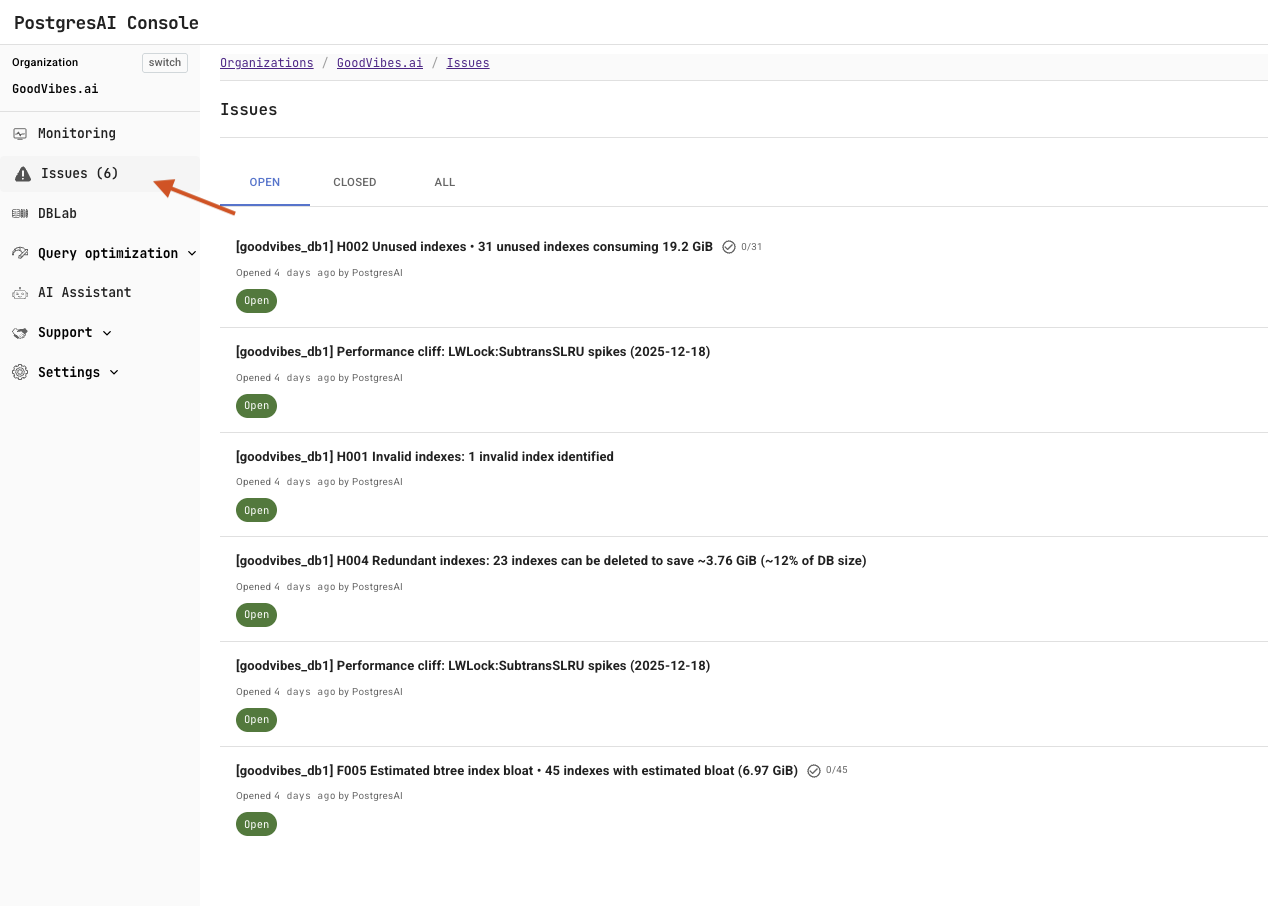
Checkup findings as Issues in the PostgresAI Console. How it works
PostgresAI and EDB Postgres Enterprise Manager, side by side
| Question | PostgresAI | EDB Postgres Enterprise Manager |
|---|---|---|
| What it is | PostgreSQL monitoring with scheduled health checkups. Findings become Issues with severity, evidence and a recommended fix, which you, your AI agent or a PostgresAI expert can act on. docsdocs 2 | A monitoring and management tool based on pgAdmin 4. Agents report host and database metrics to a PEM server, which provides dashboards, alerts, SQL Profiler, Performance Diagnostic, Capacity, Log and Audit Managers and admin tools. Version 10.6 was released on 29 September 2026. 23620 |
| Where your Postgres can run, and which versions | YesAmazon RDS and Aurora, Google Cloud SQL, Azure Database for PostgreSQL, Supabase, Tiger Data, self-managed servers and Postgres running on Kubernetes. PostgreSQL 14 and newer, with the pg_stat_statements extension. docs | PartlyPostgreSQL, EDB Postgres Advanced Server and EDB Postgres Extended 14 to 18, on hosts where you install a PEM agent, plus remote monitoring for Amazon RDS and EDB's own cloud service, where some features are limited or missing. Every monitored server must be covered by an EDB Standard or Enterprise subscription. 254 |
| Where it runs and what it collects | YesHosted by PostgresAI, or self-hosted in your own cloud account or on your own server. It collects database metadata such as statistics, normalized query texts and wait events, not table data or query parameters. docsdocs 2 | YesSelf-hosted: you install the PEM server, a Postgres backend database and a web server on Linux or Windows hosts. Monitoring data is stored in the pem database on your backend. 3610 |
| Open source | YesThe monitoring software is open source under Apache 2.0. Hosted plans are a separate paid service. docsdocs 2 | Not documentedPEM is based on the open-source pgAdmin 4 project and requires an EDB Standard or Enterprise subscription. The PEM REST API documentation lists its license as the Limited Use Software License Agreement. The sources we reviewed do not describe PEM's own source code as public. 2415 |
| Query performance analysis | YesTop queries from pg_stat_statements by calls, execution time, planning time and rows, with a drill-down dashboard for a single query. For execution plans, Joe runs EXPLAIN on a DBLab clone. docsdocs 2 | YesSQL Profiler, an extension enabled on each server, records query plans, buffer usage and execution times, with an optional minimum duration. AI Insights, when an LLM provider is configured, reviews EXPLAIN plans and suggests fixes with SQL. 83109 |
| Wait event analysis | YesAn ASH-style wait event dashboard built from samples of pg_stat_activity. No extra extension is needed. docs | YesThe Performance Diagnostic dashboard shows active sessions by wait event type in 15-second points, with the top 15 queries. It needs the EDB wait states module, loaded through shared_preload_libraries, which requires a restart. 7 |
| Health checks and recommendations | YesScheduled checkup reports on settings, autovacuum and bloat, and indexes (invalid, unused, redundant). Each finding becomes an Issue with severity, evidence and a specific fix. docsdocs 2 | YesPredefined alert templates, including size-aware autovacuum and autoanalyze overdue alerts added in 10.6. AI analysis reports on security, performance and schema design list findings by severity with SQL, once an LLM provider is enabled. Tuning Wizard, Postgres Expert and Index Advisor were removed in 10.0. 1311910 |
| AI and agent access | YesThe postgresai CLI (alias pgai) and an MCP server with tools for Issues, action items and checkup reports. The setup guide covers Cursor, Claude Code, Windsurf and Codex. docsdocs 2 | PartlyA REST API and a CLI for exporting and importing alert templates and probes. An AI Assistant chat in the Query tool writes SQL from plain language, using Anthropic, OpenAI, Ollama or Docker Model Runner. The sources we reviewed do not describe an MCP server for PEM. 15169 |
| Testing a fix before production | YesWith DBLab Engine, a separate open-source product: a full-size thin clone of the database in seconds, where an index or query change can be run on real data. DBLab is set up and priced separately. docsdocs 2 | Not documentedThe AI Insights docs advise testing a recommended index or configuration change against your own workload before production. The sources we reviewed do not describe a copy or clone for that in PEM. 9 |
| Human PostgreSQL experts | YesScale includes two expert requests a month, answered within 24 business hours. Either plan can buy a one-off pack of two requests for $500. Consulting is separate. docsdocs 2 | YesEDB offers support for PostgreSQL with patching, operations, diagnostics, upgrades and performance, 24x7x365, plus technical account management and other services. 1 |
| Alerts | Email and Slack alerts on Starter and Scale. docs | Thresholds on any metric trigger high, medium or low alerts on the Global Overview dashboard. Notifications go by email over SMTP, webhooks, SNMP or Nagios, or run a script. 1312 |
| History kept | 14 days on Starter, 13 months on Scale, custom on Enterprise. docs | Set per probe: each probe has a data retention setting for how long its history is kept in the PEM backend database you run. 143 |
| Security attestations | SOC 2 Type 2 examination completed for the Security and Availability criteria, covering March 4 to June 4, 2026. The SOC 3 report is public. docs | The EDB Trust Center lists a SOC 2 report. PEM is self-hosted, so monitoring data stays in your own PEM backend database. 193 |
Pricing
| Product | Plan | List price | Notes |
|---|---|---|---|
| PostgresAI | Starter | $16 per cluster/month | Primary only, 14-day retention, no expert requests included |
| PostgresAI | Scale | $512 per cluster/month | Primary and up to 5 replicas in one cluster, 13-month retention, Grafana dashboards, 2 expert requests a month |
| PostgresAI | Enterprise | Custom | Contact sales |
| PostgresAI | Self-hosted | No licence fee | Open source under Apache 2.0; you run it yourself |
| EDB Postgres Enterprise Manager | EDB Standard or Enterprise subscription | No public price | PEM is included; every monitored Postgres server must be covered, and the PEM server and backend consume no cores 4118 |
List prices on 18 Nov 2026. The billing units differ, so this is not a total-cost comparison. The PEM licensing page refers to EDB Standard and Enterprise subscriptions; the EDB plans page now lists EDB Postgres AI plans such as Enterprise Postgres. An EDB Community 360 subscription is not enough to monitor a server with PEM. PostgresAI pricing
Using PostgresAI with EDB Postgres Enterprise Manager
DBLab is a separate product that copies any PostgreSQL source, so a team that monitors PostgreSQL with PEM can try an index suggested by AI Insights on a full-size DBLab clone before production, as the PEM docs advise.
Questions
- Is EDB Postgres Enterprise Manager free?
- No separate price is published. PEM is included with EDB Standard and Enterprise subscriptions, and every Postgres server it monitors must be covered by one of them; EDB Community 360 is not enough. 41
- Does EDB Postgres Enterprise Manager work with Amazon RDS?
- Yes, through remote monitoring with an agent on another host. Some features are limited: dashboards lack operating system data, and Audit Manager and Log Manager are not supported. The RDS server must be covered by an EDB Standard or Enterprise subscription. 54
- Does PEM still have Index Advisor and Tuning Wizard?
- No. The PEM 10.0 release notes say Log Analysis Expert, Tuning Wizard, Postgres Expert and Index Advisor were removed, and point to the EDB Postgres Tuner extension for tuning. PEM now has AI analysis reports and AI Insights for plans, which need an LLM provider. 109
- How does PEM relate to EDB Postgres AI and Hybrid Manager?
- EDB documents PEM under EDB Postgres AI, Platform and tools, and released PEM 10.6 on 29 September 2026. Hybrid Manager, which provisions and manages clusters in EDB Postgres AI, has its own dashboards built on Prometheus, Grafana and Loki. The sources we reviewed do not describe one replacing the other. 22017
- Can I use PostgresAI and EDB Postgres Enterprise Manager together?
- Yes, for PostgreSQL. DBLab, the PostgresAI cloning product, copies any PostgreSQL source, so an index suggested in PEM can be tested on a full-size DBLab clone before production.
Check it on your own database
The express checkup works with PostgreSQL 14 or newer. With --no-upload it needs no account and sends no report data to PostgresAI. It needs Node.js 18 or newer and a database role with pg_monitor. Compare what it finds with what your current tool shows for the same database.
Sources
- EDB Postgres Enterprise Manager product page
- PEM documentation: overview and Postgres compatibility
- PEM documentation: components and architecture
- PEM documentation: how PEM licensing works
- PEM documentation: remote monitoring
- PEM documentation: monitoring performance
- PEM documentation: Performance Diagnostic
- PEM documentation: profiling workloads
- PEM documentation: configuring AI features
- PEM 10.0.0 release notes
- PEM 10.6.0 release notes
- PEM documentation: notifications
- PEM documentation: alerts
- PEM documentation: probes
- PEM documentation: REST APIs
- PEM documentation: command line interface
- EDB Postgres AI Hybrid Manager documentation
- EDB Postgres AI plans
- EDB Trust Center
- PEM release notes
These pages compare what each product does for PostgreSQL; other databases and the rest of the stack are out of scope. What we say about the other product comes from its own documentation, pricing page, changelog or source repository, read on the date shown; each row cites its source. "Not documented" means we did not find it in those sources, not that the product cannot do it. Prices are list prices and the billing units differ, so they are not a total-cost comparison. Product names are trademarks of their owners. Found a mistake? Tell us and we will correct the page.
More comparisons
- Datasentinelopen source with fixes vs session and plan data
- pganalyzeopen source vs plan and log insights
- pgDashopen source with wait events vs pgmetrics reports
- pgEdge AI DBA Workbenchhuman experts vs an AI assistant
- pgMustardwhole-database monitoring vs one plan at a time
- Amazon DevOps Guru for RDSany cloud vs ML on RDS (closing)
- Azure PostgreSQL built-in toolsany provider vs Azure only
- Cloud SQL Query Insightsany provider vs inside Cloud SQL
- All comparisons